The Ultimate Guide to Black Tourmaline: Grounding, Meaning, and Daily Protection
TABLE OF CONTENTS
- What Is Tourmaline? Science and Physical Properties of Schorl
- Black Tourmaline Meaning: Spiritual Anchoring and Energetic Boundaries
- Cross-Cultural Symbolism: From Ancient Lore to Eastern Wisdom
- What Is Black Tourmaline Good For? Benefits in Holistic Practice
- Benefits of Wearing Black Tourmaline Jewelry
- Finding Stillness in the Noise
- Frequently Asked Questions (FAQ)
Have you ever had this experience: you just stepped out of an intense meeting or walked away from a crowded gathering, and while your body isn’t physically tired, you feel hollowed out? Your mind feels scattered, your emotional state feels heavy, and your presence has been quietly diluted.
In crystal healing, Feng Shui, and traditional protective practices, black tourmaline exists for moments like these. It is not shiny. It does not demand attention. Yet across holistic traditions, it has earned a permanent place: the stone of grounding, the stone of boundaries.
This guide isn’t a list of magical promises. We’ll look at what it actually is in the earth, why ancient lineages treated it as a boundary stone, and how to use it in daily life when the world gets a little too loud.

What Is Tourmaline? Science and Physical Properties of Schorl
Put simply: it is the iron-rich heavyweight of the tourmaline family, known in mineralogy as Schorl.
Three core facts tell you everything you need to know:
Name: Schorl, the most abundant variety of tourmaline.
Hardness: 7 to 7.5 on the Mohs scale—harder than obsidian, capable of scratching glass.
The Color: A deep, opaque black driven by high iron content.
Belonging to the trigonal crystal system with a density around 3.03 to 3.25 g/cm³, schorl forms with clear structural geometry and an uneven fracture. For mindfulness, this physical reality matters: it is a stone with weight, density, and distinct edges. When we talk about grounding and boundaries, that physical architecture is where the concept starts.
Tourmaline also exhibits natural piezoelectric and pyroelectric properties—releasing a faint electrostatic charge when exposed to pressure or temperature shifts. Industry relies on this for pressure gauges and infrared sensors. Holistic traditions took that same trait and interpreted it as an innate responsiveness to subtle shifts in an environment. That’s cultural narrative, not clinical science, but it’s why black tourmaline holds such a unique place in holistic circles.

Black Tourmaline Meaning: Spiritual Anchoring and Energetic Boundaries
Its real gift isn’t deflecting the outside world—it is dropping an anchor back into your body and the present moment.
Grounding and the Root Chakra (Muladhara)
Grounding is the single most referenced attribute of black tourmaline. Its connection to the Root Chakra (Muladhara) is the foundation of traditional energy work. Sitting at the base of the spine, the Root Chakra governs your baseline sense of security, stability, and belonging.
When your thoughts are scattered and you feel untethered, practitioners treat black tourmaline as an anchor. It doesn’t erase difficult emotions. It simply pulls scattered mental chatter back into the physical frame. In the words of longtime practitioners, it helps you come back into your own skin.
Boundaries Over Walls
Black tourmaline is often labeled a protection stone, but genuine protection is frequently misunderstood:
It is not a wall built to lock you away from the world.
It is a conscious, permeable perimeter that lets you perceive your surroundings without absorbing them.
Real boundary work lets you stay empathetic without burning out; it lets you walk into a tense room without letting that tension take over your day. Genuine protection helps you show up more steadily in your life—not hide from it.

Cross-Cultural Symbolism: From Ancient Lore to Eastern Wisdom
Across centuries, diverse traditions independently assigned black tourmaline the same role: shelter, structure, and calm.
Ancient Greece: Remembered in lore as a stone of order, trusted to settle internal chaos.
Indigenous African Traditions: Worn as an amulet to quiet discordant environments and preserve a sense of safety.
Vedic Lineages: Linked to the root center to keep the mind steady during meditation.
Ancient Egyptian Lore: Often cited in trade accounts as a guardian stone, though archaeological proof remains conversational.
Chinese and Taoist Context: In Chinese, tourmaline (Bixi) sounds identical to Bixie, an ancient phrase for warding off discordant energy. In Five Element balance, black belongs to Water—quiet, deep, and steady. In classic spatial harmony, black gemstones are defensive anchors: they don’t fight chaos; they simply give chaos nowhere to land.
Different cultures, one shared instinct: black represents depth, boundaries, and grounding.

What Is Black Tourmaline Good For? Benefits in Holistic Practice
In mindful living traditions, black tourmaline serves three distinct purposes: energy transmutation, root-level stability, and spatial boundaries.
(Note: These perspectives reflect traditional crystal philosophy and do not replace professional medical or mental health care.)
1. Transmuting Tension
Traditional practitioners describe black tourmaline as a transmuter rather than a shield. Instead of bouncing energy back, it absorbs heavy, scattered friction and grounds it back into the earth. In Eastern metaphysics, it is described as clearing stagnant atmosphere (Zhuo Qi).
Because it acts like an energetic filter, regular maintenance matters. Once it takes on too much, traditional practice resets it under moonlight, on a quartz cluster, or with smoke cleansing. A grounding stone isn’t a passive appliance—it’s an ongoing relationship.
2. Settling the Root Center in High-Stress Modern Life
The mental hangover from long corporate meetings, the fatigue of overthinking, the sensory noise of constant screens—these are the moments where black tourmaline belongs.
It doesn’t make your workload disappear. It gives you a physical, weighted reference point. Having it close is a tactile reminder: Your boundary is intact; come back to center. Empaths and sensitive thinkers have long relied on that quiet anchor.
3. Spatial Alignment and Feng Shui
Three straightforward placements, one common principle:
The Entryway: Placed by the front door as the first conscious boundary before external stress enters your home.
Room Corners: Placed in corners to create a grounded perimeter throughout a living space.
The Work Desk: Kept near screens to provide a grounding counterweight against digital fatigue.
The intent is simple: you aren’t removing the world’s complexities; you’re setting a clear container for your personal sanctuary.

Benefits of Wearing Black Tourmaline Jewelry
Wearing a stone turns an abstract philosophy into a portable, personal ritual.
Crystals don’t work like automatic switches. In conscious traditions, you set an intention when you put a piece on—whether that’s calm, clear boundaries, or mental focus. The piece then becomes a sensory cue. Every time you feel the cool beads on your wrist or the weight against your chest, it calls you back into the present moment.
Which Hand Should You Wear It On?
Traditional energy philosophies often note:
The Right Hand: The side of outward action and release—ideal when your focus is letting go of built-up tension and projecting clear boundaries.
The Left Hand: The receptive side—ideal when you want to keep your personal space from taking on surrounding moods.
Trust your own instinct here. Wear it on whichever side makes you feel more settled.
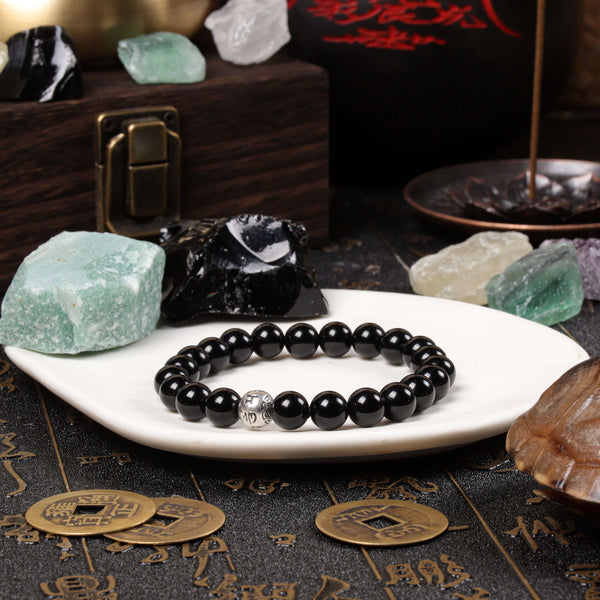
If you are looking for an everyday companion for this practice, HVibeTune’s black tourmaline bracelets translate traditional Feng Shui and Taoist grounding into clean, Modern Zen designs. They aren’t meant to be loud fashion statements; they are personal anchors for daily mindfulness, complemented by pendants and raw display stones for spatial balance.

Finding Stillness in the Noise
It does not change how loud the world is; it changes how close you let that noise get to you.
Black tourmaline makes no wild claims. It doesn’t replace inner work or professional care. Its real value is quiet utility: weight, stability, clear edges, and presence.
From ancient Greek philosophy to Five Element metaphysics, every tradition arrives at the same point: true resilience isn't about building a fortress around yourself. It’s about learning to stay rooted in your own center, even when things around you are moving fast. The stone is simply a tangible reminder. The boundary has always been yours to set.

Frequently Asked Questions (FAQ)
Can black tourmaline get wet, and how do you cleanse it safely?
While natural tourmaline has a solid Mohs hardness of 7 to 7.5, soaking it in water—especially salt water—is not recommended. Schorl is an iron-rich stone with microscopic natural fissures, and polished jewelry pieces are often gently finished for comfort. Prolonged water exposure can dull its luster or weaken the stone over time.
-
Gentle Cleansing Methods: Place it under overnight moonlight, set it on a clear quartz cluster, or run it through herbal incense or sage smoke.
-
Recommended Timing: Cleanse every 1 to 2 weeks for daily wear, or once a month if worn occasionally.
Can you sleep with black tourmaline?
Yes, but it depends on how sensitive you are. Many find its grounding nature soothes an overstimulated evening mind. If you are especially sensitive and find its grounded vibration too heavy for deep sleep, simply place it on your nightstand or near the foot of the bed. Always let sleep quality make the final call.
How can you check if black tourmaline is real?
Keep an eye out for these four signs:
-
Luster: It carries a vitreous (glassy) to sub-metallic sheen.
-
Natural Striations: Raw tourmaline shows distinct vertical parallel grooves and internal fractures; it should never look smooth or plastic-like.
-
Temperature: It feels cool to the touch at first and warms gradually against skin.
-
Hardness: At 7 to 7.5 Mohs, natural tourmaline easily scratches glass. Watch out for suspiciously light, cheap black glass or resin beads.
Black Obsidian vs. Black Tourmaline: What is the metaphysical difference?
-
Black Obsidian: A volcanic glass (Hardness 5 to 5.5). In energy traditions, obsidian works like a sudden vacuum—rapidly drawing out heavy emotional patterns and forcing things to the surface. It is often used for acute clearing.
-
Black Tourmaline (Schorl): A dense, structured crystalline mineral (Hardness 7 to 7.5). Its focus is slow, steady anchoring—helping you hold your center through ordinary days.
They work well together: reach for obsidian when clearing out heavy feelings, and tourmaline for daily balance.
Black Onyx vs. Black Tourmaline: How do they differ?
Black Onyx is a microcrystalline chalcedony (Hardness 6.5 to 7) with a uniform, silky, opaque surface. Traditionally, onyx is associated with endurance, patience, and mental resolve. Black tourmaline stands apart with its visible crystalline striations and electrical traits, focusing primarily on grounding and energetic boundaries.
Can you wear black tourmaline with other crystals?
Yes. Traditional practices encourage intuitive pairings:
-
Black Tourmaline + Amethyst: Grounds your energy while keeping the mind quiet and clear.
-
Black Tourmaline + Rose Quartz: Holds your personal boundaries without closing off empathy or warmth.
-
Black Tourmaline + Clear Quartz: Amplifies schorl's natural grounding effect.
Pair them according to the mindset you want to cultivate each morning.