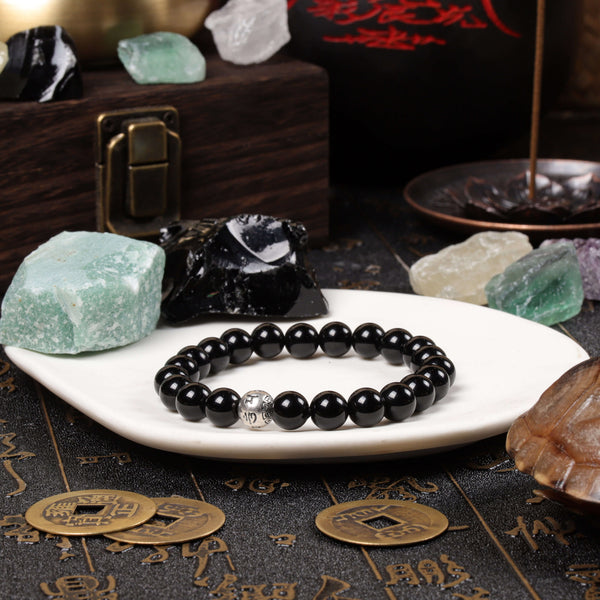
Real vs Fake Black Obsidian: How to Spot Counterfeit Volcanic Glass Before You Buy
TABLE OF CONTENTS
Natural black obsidian has become one of the most highly sought-after materials for personal jewelry, minimalist home decor, and energetic grounding. Unfortunately, its massive popularity also makes it a primary target for counterfeiters. If you browse any major online marketplace today, you will find countless listings for a black obsidian crystal or bracelet that is actually cheap plastic, dyed industrial glass, or common black agate sold under a deceptive name.
This guide provides a comprehensive, material-science deep dive into the physical reality of this unique stone. We strip away the fluff to give you hard, practical, at-home verification methods to easily separate genuine volcanic glass from clever fake black obsidian placebos.

The Material Baseline: Understanding Authentic Black Obsidian Properties
Before you can accurately identify a counterfeit, you must understand the raw geological baseline of what a genuine stone actually is.
Definition and Formation
Geologically speaking, obsidian is not an actual crystal; it is a natural volcanic glass. It forms during intense tectonic events when silica-rich felsic lava erupts from the earth and cools so rapidly that the liquid atoms have zero time to arrange themselves into a structured, geometric crystal lattice. The result is an amorphous solid—a natural glass forged by the earth.
Core Black Obsidian Properties
To run an accurate assessment, keep these foundational physical metrics in mind:
Black Obsidian Hardness: Sits between 5 and 5.5 on the Mohs scale, making it slightly harder than standard household window glass.
Fracture Patterns: It exhibits a distinct conchoidal fracture. This means when the material breaks, it cleaves into smooth, curved, shell-like surfaces with razor-sharp edges—a classic footprint of pure glassy materials.
Density and Specific Gravity: Typically ranges between 2.35 and 2.60 g/cm³. In your hands, it will feel noticeably heavier than acrylic plastic but lighter than dense metals like iron or steel.
The Crucial Misconception
A genuine black obsidian stone is neither a crystal nor a variation of agate. It is entirely distinct from "black quartz" or black onyx (which is a cryptocrystalline quartz). Sellers who market their inventory as "obsidian crystals" are merely using a loose, unscientific trade name. Understanding this geological distinction is your first line of defense against deceptive marketplace copy.
Visual Identification: Scanning the Distinct Variations of Genuine Obsidian
Not all volcanic glass looks identical. Authentic specimens fall into a few clearly defined geological categories. Counterfeiters routinely fail to replicate these varieties because they rely on cheap surface paint or uniform factory casting instead of natural earth processes.
Pure Black Obsidian
In standard, reflected daylight, this primary variety appears entirely jet-black, dense, and opaque. However, its true identity is revealed the moment you examine it closely under a concentrated light source. Authentic pure black obsidian is never flat or dead-black like synthetic acrylic; its thin edges will always showcase a subtle, natural translucency.
Rainbow Obsidian
This is arguably the most famous and striking variation. When exposed to a focused, high-intensity light source—such as direct sunlight, a smartphone flashlight, or a concentrated desk lamp—the interior layers of a genuine rainbow obsidian piece will display beautiful, shifting concentric rings of iridescent color. These shimmering eyes range from soft blues and greens to deep purples, reds, and golds. They are caused by microscopic fields of water vapor or nanoparticle bubbles trapped within the flowing lava, which naturally refract light waves.
The Fake Red Flag: Counterfeit rainbow obsidian typically looks like a superficial sticker or a flat spray-paint job. The colors appear unnaturally bright, completely uniform, and fail to shift in three-dimensional depth when you rotate the stone under a light source.
Gold Sheen & Silver Sheen Obsidian
Gold sheen obsidian displays a brilliant, metallic golden flash that glides smoothly across the stone's surface as you tilt it. Its silver counterpart produces the exact same kinetic illusion in a cool, bright metallic tone. This beautiful shimmer is driven by micro-pockets of volcanic gas or mineral inclusions (such as magnetite) that aligned perfectly along the internal flow lines before solidification.
High-grade gold sheen specimens can even exhibit a distinct cat's-eye band—a sharp, singular line of light that slides dynamically across the bead. Counterfeiters attempt to mimic this depth with metallic flake paint or reflective foil backings, both of which look flat and completely lack natural holographic movement.
Ice Obsidian
Ice obsidian is highly prized for its exceptional, glass-like translucency. While it appears dark and moody in dim indoor environments, holding it up to the light reveals a beautifully clear, uniform smoky-brown or warm amber internal body. When this transparent depth coexists with subtle concentric colorful rings, it is classified as "ice rainbow obsidian"—a premium tier of the mineral.
The Fake Red Flag: This variety is heavily targeted by industrial counterfeiters. A massive percentage of "ice obsidian" listings online are nothing more than standard clear factory glass treated with a dark chemical tint or smoky coating.
Snowflake Obsidian
Authentic snowflake obsidian is structurally impossible to mistake once you know what to look for. The dark volcanic body houses white, flower-like clusters called spherulites—which are radial crystalline structures of cristobalite (a type of silica) that grew naturally inside the glass matrix as the lava cooled. Because these formations are organic, they are highly irregular in shape, size, and distribution.
The Fake Red Flag: Counterfeiters try to replicate this look by stamping white paint dots or gluing synthetic flecks onto cheap black beads. If you look closely through a basic lens, genuine snowflakes feature fuzzy, branch-like borders and soft gray halos where the crystals met the glass. Paint dots, by contrast, feature sharp, uniform, and completely flat circular edges.

The Translucency Light Audit: Testing Mineral Behavior Under Illumination
The single most definitive and reliable method to verify a real black obsidian bracelet or specimen at home is the light transmission test.
Tool Required: A strong point-light source, such as a high-powered LED torch or your smartphone’s flashlight.
Directing a strong light source through the thin edge of a genuine bead or stone should yield an immediate, clear translucent tint of smoky brown or olive green.
Genuine Mineral Reactions
Pure Black Obsidian: When you press a thin edge or the perimeter of a bead flat against your light source, light must pass through. It will never look completely opaque. Instead, it will reveal a soft, uniform, translucent glow of warm smoky brown, deep olive green, or light charcoal gray.
Rainbow Obsidian: Illumination will expose deep, concentric iridescent rings or crescent moon shapes that shift inside the mineral matrix as you angle the piece.
Gold & Silver Sheen: The direct light will make the metallic particles flare brilliantly. Moving the stone will reveal the micro-scale orientation of the embedded internal gas paths.
Ice Obsidian: The entire body of the stone will illuminate smoothly like a piece of antique stained glass, showing an immaculate amber or tea-brown color with absolutely zero muddy or milky internal clouds.
Counterfeit Red Flags
Dyed Factory Glass: This material emits artificially vivid, uniform neon shades—such as bright chemical green, electric blue, or solid crimson. The color saturation looks completely identical across the entire object, mimicking a commercial paint chart.
Plastic & Resin: These will either block out the light entirely due to heavy chemical dyes, or they will emit a highly turbid, muddy, and milky-white glow.
Black Agate or Onyx Substitutes: These stones process light through a completely different structural matrix. Genuine agate will reveal wavy, parallel bands of crystallization (resembling natural tree rings) rather than the immaculate, fluid homogeneity of true volcanic glass.
Somatic and Thermal Dynamics: The Cold-Touch Material Audit
Your innate physical senses provide an immediate, highly effective filter for catching a fake obsidian glass imitation upon unboxing.
Authentic Thermal Conductivity & Weight
The Shock of Cold: Natural volcanic glass features incredibly high thermal conductivity. If you press a genuine specimen against a highly sensitive skin area—such as your lower lip or the inside of your wrist—it will feel instantly and shockingly icy. Because it rapidly absorbs and dissipates your body heat, this distinct cool sensation actively persists for several seconds before slowly equalizing to your temperature.
The Physical Heft: Genuine obsidian carries a distinct, satisfying physical heft and density when held in your palms. A genuine 10mm bead strand will feel noticeably substantial and weighted, resting heavily against your pulse points.
Synthetic Temperature Red Flags
Plastic & Polymers: Feel instantly lukewarm, soft, or neutral upon physical contact. They lack geological density, feeling suspiciously lightweight, hollow, and floaty when handled.
Ordinary Industrial Glass: While mass-produced glass can feel cold initially, its surface texture feels completely slide-slick, slippery, and oily. It entirely lacks the dry, velvety, crisp ice-plate texture characteristic of authentic volcanic glass.
Microscopic Evidence: Embracing Geological Imperfections Over Flawless Fakes
Nature does not operate a pristine, sterile assembly line. If your new acquisition appears completely flawless under close inspection, you should approach it with deep skepticism.
Authentic Imperfections
When shopping for an authentic real black obsidian bracelet, a well-trained eye views micro-scale irregularities as a definitive receipt of the Earth's creation. Under a standard 10x jeweler's loupe or your smartphone's macro lens, true volcanic glass will frequently showcase:
Surface Pits: Minute, shallow natural cavities where microscopic gas bubbles or softer mineral inclusions naturally eroded away during the polishing process.
Internal Veils and Ice Cracks: Delicate, sub-surface hairline fissures or cotton-like wisps trapped inside the stone's glass body.
Flow Lines: Microscopic, elegant, wave-like striations that serve as the permanent frozen record of the viscous lava moving across the earth before it solidified.
What Counterfeiters Give You
Plastic: Completely uniform, flat, and lifeless surfaces with zero interior depth or surface variation.
Cast Glass: Industrial kiln baking frequently leaves behind perfectly round, spherical microscopic air bubbles. While natural volcanic glass can trap air, the explosive pressure and kinetic motion of erupting lava will consistently stretch, elongate, or flatten those bubbles into fine needles. If you look into a bead and see a cluster of perfect geometric circles, you are looking at man-made factory glass.
Hardness Ratings: Scratch Test Protocols (Use with Caution!)
Running an obsidian stone scratch test requires a solid understanding of the Mohs scale, but it should be approached with care to avoid ruining your jewelry. On the Mohs scale, ordinary glass measures around 5.0, authentic black obsidian sits at 5.5, and a surgical steel knife ranges from 5.5 to 6.0.
The Physical Principle
Because authentic black obsidian scores a 5 to 5.5 on the hardness scale, it is structurally harder than cheap commercial soda-lime bottle glass. This means a sharp, raw edge of genuine obsidian can easily score a permanent scratch into a common glass bottle, leaving a clean groove while shedding a fine white powder from its own ground glass material.
A Non-Destructive Alternative
Instead of marring the pristine face of a polished piece, use a surgical steel blade to gently score an inconspicuous zone—such as the interior rim of a bead's stringing hole.
On Real Obsidian: The blade will slide off or leave no mark, as high-grade steel shares a nearly identical hardness threshold.
On Plastic/Polymer Fakes: The steel will instantly carve deep into the soft material, producing a curled shaving or peeling away synthetic flakes.

The Scarcity Spectrum: Evaluating Rare Single-Color Monochromatic Variations
Beyond its classic deep black form, obsidian can naturally manifest in a stunning spectrum of solid monochromatic colorways due to the presence of trace elements like iron, magnesium, or titanium. However, these varieties are exceptionally rare. Understanding their true geological occurrence rates protects you from buying cheap novelty glass at inflated prices.
Geological Scarcity Reference Index
Purple Obsidian: ~30% of verified rare color discoveries (The most accessible monochromatic variant).
Green Obsidian: ~25% of rare color discoveries.
Deep Dark Blue Obsidian: ~4.2% of rare color discoveries.
Red Obsidian: ~3.3% of rare color discoveries.
Blue Obsidian: ~1.2% of rare color discoveries.
Sky-Blue Obsidian: ~0.53% of rare color discoveries (Incredibly elusive in nature).
Solid Golden Obsidian: ~0.07% of rare color discoveries (Refers to a body that is completely saturated with gold, not just a surface sheen; highly coveted by collectors).
Mahogany Obsidian: A beautiful, more accessible variety featuring rich, iron-infused ribbons of deep reddish-brown and black stripes interlocking organically together in swirling splotches.
Expert Procurement Tip: If an online retailer offers an entire strand of uniform purple obsidian or sky-blue obsidian beads for under $20 to $30, it is virtually guaranteed to be synthetic slag glass or chemically dyed industrial crystal. True monochromatic volcanic glass is priced strictly according to its global geological scarcity.
Why Choose HVibeTune: Cosmic Precision
When selecting a protective personal asset, the difference between a mass-market plastic imitation and a highly responsive environmental filter comes down to strict material purity and intentional calibration. At HVibeTune, we reject industrial shortcuts to ensure absolute energetic resonance.
100% Raw Material Commitment
We guarantee 100% natural, untreated volcanic glass sourced directly from verified tectonic fields. Every single bead easily passes the most stringent physical and geological authenticity audits. We enforce an absolute ban on synthetic crystals, polymer dyes, acid-washing, or artificial radiation treatments, preserving the raw atomic integrity of the stone.
The Cosmic Precision Framework: Heaven · Earth · Human
Our lineage and workflow are built upon an expert, data-driven system. We reject personal mystiques and guru marketing gimmicks. Our team operates entirely within the systemized data structures of the orthodox Zi Fu Qi Men school—a timeless heritage passed down systematically from Grandmaster Wang Fenglin to our Feng Shui Master.
Heaven & Earth (Cosmic Convergence): Every lifestyle instrument is handcrafted and polished exclusively during mathematically calculated auspicious hours, assembling the earth minerals when natural environmental energy fields and celestial mechanics are in perfect alignment.
Human (The Crystalline Lock): Under the direct guidance of our Feng Shui Master, each piece undergoes a dedicated frequency initialization process. Every instrument spends a mandatory 5 days resting inside our stationary environmental static chambers prior to fulfillment. This intensive step thoroughly wipes out all transport-static noise and locks the pristine protective frequency directly into the mineral’s crystalline lattice.
Secular Integration: Our workflow is 100% non-religious and universal. Each tool arrives with a beautifully styled geometric Frequency Alignment Card. Upon unboxing, a simple, 1-minute secular intention-binding ritual pairs the raw physics of the stone directly with your personal focus center, requiring zero dogmas or belief systems.

Frequently Asked Questions (FAQ)
Q1: How can I quickly spot a fake black obsidian bracelet in one second when shopping online?
A: While you cannot gain absolute certainty from product photography alone, you can instantly filter out 90% of fraudulent listings with two protocols. First, check the image carousel for a backlit shot demonstrating edge translucency; if a seller cannot provide a photo of the stone under light, look elsewhere. Second, the moment your package arrives, perform the lip test: press a bead directly against your lower lip. If it feels lukewarm or reaches room temperature within a single second, combine that with its weight—if it feels light and warm, it is plastic.
Q2: I don't wear jewelry. How can I still experience the protective properties of black obsidian?
A: You do not need to wear a bracelet to experience environmental energy calibration. If you prefer to keep your style entirely unadorned, look into modern Zen office feng shui ornaments. Placing a minimalist black obsidian mountain sculpture or a balanced desktop energy balancing ornament on the left side of your workspace commands the room's environmental energy flow, traditionally known as anchoring the room's natural energy or life force. It creates an unbreachable sanctuary that neutralizes corporate friction and decision fatigue without requiring you to change your personal wardrobe habits.
Q3: Can I wear real black obsidian to sleep, or put it in direct sunlight for cleansing?
A: Can you wear obsidian to sleep? Yes, it is highly recommended. Keeping a genuine grounding tool close to your body during rest helps downregulate your cortisol loops, signaling your nervous system to drop out of fight-or-flight thinking and settle into deep sleep recovery. However, you must exercise caution regarding black obsidian in sunlight. Because it is a natural volcanic glass, intense UV radiation and sudden solar heat introduce severe thermal stress to the material, which can spread microscopic internal fractures and permanently cloud its mirror finish. Protect your asset by cleansing it under gentle, natural full moon moonlight or rinsing it with cool running water.
Q4: I am shopping at the last minute; how quickly can these calibrated tools be fulfilled?
A: Because we strictly honor our mandatory 5-day stationary configuration window to thoroughly clear out transit noise and lock in the mineral's baseline frequency, our highly calibrated crystalline tools cannot be rushed. If you are facing a tight holiday deadline, we suggest exploring our immediate-ship premium quiet-luxury apparel lines or opting for an instant, elegant Digital HVIBETUNE Gift Card, allowing your recipient to personally select and initialize the exact protective instrument that matches their current professional path.
Related Blog Posts
The Black Obsidian Guide: Protect Your Aura, Block Negative Energy, and Ground Your Daily Flow