The Ultimate Smoky Quartz Guide: Meaning, Symbolism, Properties, Benefits, Care & FAQs
TABLE OF CONTENTS
- What Is Smoky Quartz?
- History and Cultural Lineage of Smoky Quartz
- Smoky Quartz Spiritual Meaning and Modern Mindfulness
- Which Smoky Quartz Form Fits Your Lifestyle?
- Physical and Gemological Properties of Smoky Quartz
- How to Identify Genuine Smoky Quartz: Authenticity & Buying Guide
- What Chakra Is Smoky Quartz Associated With?
- What Are the Benefits of Smoky Quartz?
- What Crystals Go Well with Smoky Quartz?
- How to Wear Smoky Quartz: Jewelry Styling & Everyday Practice
- How to Cleanse Smoky Quartz and Keep It Charged
- Frequently Asked Questions (FAQ)
Quick Summary & Key Takeaways:
Primary Frequency: Somatic grounding, emotional equilibrium, mental clarity, and stress dissipation.
Mineral Profile: Macrocrystalline quartz (SiO₂), Mohs hardness 7.0, naturally colored by geothermal irradiation.
Chakra Resonance: Anchored to the Root Chakra (Muladhara) with an energetic bridge to the Crown Chakra (Sahasrara).
Golden Care Rules: Completely safe for brief water cleanses; strictly protect from prolonged direct sunlight to prevent color fading.

What Is Smoky Quartz?
Smoky quartz is a semi-transparent to translucent variety of crystalline quartz that ranges in color from delicate champagne and light amber-brown to rich cognac, deep chocolate, and opaque black. As an authentic variety of the earth’s most abundant mineral family—quartz (silicon dioxide, SiO₂)—smoky quartz pairs the exceptional physical durability of quartz with an unmistakable, warm earth-toned translucence.
Chemical & Physical Parameters
| Property | Parameter |
| Chemical Formula | SiO₂ (Silicon Dioxide) |
| Crystal System | Trigonal / Hexagonal |
| Mohs Hardness | 7.0 (Highly resistant to daily scratches) |
| Density (Specific Gravity) | 2.65 g/cm³ |
| Refractive Index | 1.544 – 1.553 |
| Birefringence | +0.009 |
| Luster | Vitreous (Glass-like brilliance) |
| Fracture | Conchoidal |
| Streak | White |
| Fluorescence | Typically Inert |
How Does Smoky Quartz Get Its Color? The Science of Color Centers
Pure macrocrystalline quartz is naturally clear and colorless. How does smoky quartz develop its signature earthy palette?
The answer lies in natural geothermic irradiation. During crystal formation within granitic host rock, trace aluminum impurities substitute for silicon ions within the crystal lattice (aluminum replacing silicon). Over millions of years of exposure to low-level natural background radiation emitted by surrounding rocks, an electron is displaced. This transfer activates color centers—microscopic lattice defects that selectively absorb specific wavelengths of visible light, producing its classic smoky hue.
Unlike amethyst (colored by iron impurities) or rose quartz (colored by microscopic mineral fibers), smoky quartz is colored by radiation-induced lattice defects, a process that requires geologically slow timescales to occur naturally.
Traditional Names & Varietal Terms
Across cultures and geological trade routes, smoky quartz is recognized under several historic names:
Tea Quartz: The cherished East Asian designation, celebrating stones that mirror the clear, warm amber transparency of fine steeped tea.
Morion: The classical European mineralogical name for very dark brown to pitch-black, near-opaque crystals.
Cairngorm: The historic Scottish designation, derived from the Cairngorm mountain range where fine specimens were historically gathered.
Smoky Crystal: A classical lapidary term for translucent, faceted specimens.
Global Sources & Origins
Smoky quartz deposits are found worldwide. The most prominent ethical sources include Brazil, Australia, Switzerland, Russia, Iran, Madagascar, Sri Lanka, and the United States (notably Colorado and California). The Alpine smoky quartz crystals of Switzerland are prized by collectors for their needle-sharp clarity, while Scotland’s Cairngorm deposits hold profound cultural significance.

History and Cultural Lineage of Smoky Quartz
Across thousands of years of human history, smoky quartz has held an enduring position as an emblem of balance, mindful presence, and grounded heritage in both Eastern and Western traditions.
The Scottish National Gemstone (Cairngorm)
Smoky quartz is widely recognized as Scotland’s national gemstone. Known locally as Cairngorm, it has been gathered from the Scottish Highlands since antiquity. Celtic and Druidic traditions dating back to 300 BCE revered it as a sacred stone of earth energy. From the 18th century onward, it became an essential hallmark of Highland heritage, adorning formal shoulder brooches, kilt pins, dirk handles, and ceremonial snuff mull seals.
Ancient Chinese Song Dynasty “Sun-Lenses”
In 12th-century China during the Song Dynasty, lapidary artisans cut and polished flat slabs of clear smoky quartz into the earliest functional sunglasses recorded in human history. As documented in classical court texts such as Liu Qi’s Gui Qian Zhi, magistrate judges wore these smoky crystal lenses while presiding over legal proceedings. The purpose was not merely to shield the eyes from glare, but to veil their subtle eye movements and immediate emotional responses during testimony—maintaining an aura of impartial composure, steady dignity, and calm authority.
Ancient Roman & Victorian Mourning Jewelry
In ancient Rome, smoky quartz served as a stone of quiet solace during times of loss, helping individuals maintain emotional stability while moving through grief. During the 19th-century Victorian era, the stone became central to mourning jewelry. Set into rings, lockets, and brooches, its deep, warm-brown tone symbolized dignified remembrance, composure, and emotional grounding.
The Monastic Heritage of Medieval Europe
In medieval European monasteries, deep-toned smoky quartz was held by contemplative monks. Revered as an emblem of self-discipline, focus, and humility, it served as a tactile reminder to anchor the mind, remain undisturbed by external chaos, and nurture quiet inner devotion.

Smoky Quartz Spiritual Meaning and Modern Mindfulness
Grounding Energy: The Core Foundation
The fundamental spiritual meaning of smoky quartz is grounding—cultivating a profound, stabilizing connection to the physical earth. As a classic "Stone of the Earth," it serves as an emotional anchor, drawing scattered thoughts, racing impulses, and nervous overstimulation back into calm equilibrium. In mindfulness practices, it keeps awareness anchored so that creative or intellectual pursuits remain rooted in practical application.
Protective Presence
Smoky quartz is valued as a natural energetic buffer. Rather than reacting defensively, it absorbs, neutralizes, and releases dense environmental tension into the earth to be harmonized. In modern workplaces, it is frequently placed beside laptops, monitors, and smartphones to cultivate a calm digital boundary and counteract screen fatigue.
Resilience & Composure Under Pressure
Smoky quartz embodies calm resilience. It stabilizes the emotional state during demanding life transitions, encouraging clear-headed decisions, pragmatic action, and steady composure when external situations feel chaotic.
Pragmatic Problem-Solving
The stone stands for grounded realism. It dispels paralyzing overanalysis, procrastination, and unproductive rumination, encouraging tangible steps and constructive focus.

Which Smoky Quartz Form Fits Your Lifestyle?
Different physical cuts and geological geometries naturally support distinct daily routines and mindfulness practices:
| Crystal Form | Primary Benefit | Recommended Placement & Practice |
| Natural Point / Tower | Directed focus & environmental clarity | Place on your desk between your keyboard and monitor to stabilize workday focus. |
| Polished Palm Stone | Somatic stress relief & touch therapy | Hold during deep-breathing exercises; rub with your thumb to relieve sudden sensory overwhelm. |
| Smooth Sphere | Multi-directional harmonious balance | Display in living rooms or meditation corners to radiate a calm, uninterrupted atmosphere. |
| Beaded Bracelet (8mm–10mm) | Continuous all-day personal grounding | Wear on your non-dominant wrist (the receptive side) for steady energetic centering. |
| Raw Cluster / Specimen | Architectural presence & unrefined energy | Keep near entryways or workspaces to create an anchored visual sanctuary. |

Physical and Gemological Properties of Smoky Quartz
Complete Mineralogical Specifications
| Mineral Property | Detailed Specification |
| Chemical Formula | SiO₂ |
| Classification | Tectosilicate, Quartz Group |
| Crystal System | Trigonal (alpha-quartz) / Hexagonal (beta-quartz) |
| Space Group | P3₁21 or P3₂21 |
| Unit Cell Parameters | a = 4.9133 Å, c = 5.4053 Å |
| Mohs Hardness | 7.0 |
| Density (Specific Gravity) | 2.65 g/cm³ (pure) / 2.59–2.63 (inclusion-rich) |
| Refractive Index | 1.543 – 1.554 |
| Birefringence | +0.009 |
| Optical Character | Uniaxial positive (+) |
| Luster | Vitreous |
| Cleavage | None |
| Fracture | Conchoidal to uneven |
| Streak | White |
| Diaphaneity | Transparent to nearly opaque |
| Pleochroism | Weak to distinct (reddish-brown to greenish-brown) |
| Melting Point | 1670°C (beta-tridymite); 1713°C (beta-cristobalite) |
Characteristic Geological Inclusions
Rather than lowering quality, authentic inclusions confirm geological provenance and impart distinct character:
Rutilated Smoky Quartz: Fine, luminous needles of golden, red, or coppery rutile embedded within the crystal.
Apatite & Tourmaline Prisms: Deep blue, green, or black mineral needles suspended within a clear amber matrix.
Chlorite & Hematite Phantoms: Earthy, organic ghost-like layers that outline the crystal's historic growth stages.
Natural vs. Artificially Irradiated Quartz
In commercial gem markets, clear quartz is frequently exposed to artificial laboratory irradiation (such as industrial electron beams or Cobalt-60 gamma rays) to artificially darken stones into deep charcoal or black tones within minutes.
Both natural and treated stones are real silicon dioxide, completely non-radioactive, and safe to handle. However, natural smoky quartz represents millions of years of patient geological formation, while laboratory-treated pieces are artificially darkened in bulk. Discerning buyers value natural provenance, gentle color zoning, and authentic warmth over uniform, mass-treated black quartz.

How to Identify Genuine Smoky Quartz: Authenticity & Buying Guide
Diagnostic Matrix: Natural vs. Artificial vs. Glass
| Diagnostic Feature | Natural Smoky Quartz | Artificially Irradiated Quartz | Glass Imitation |
| Color Saturation | Subtle color zoning; soft gradients; warm tea and cognac undertones. | Uniform, flat, inky jet-black; often lacks warm amber translucence. | Monochromatic, flat color throughout with zero organic nuance. |
| Microscopic Interior | Natural growth lines, microscopic mineral veils, fluid cavities. | Clean or heavily fractured; lacks natural growth banding. | Round or elongated air bubbles; curved flow lines from molten pouring. |
| Optical Double Refraction | Shows subtle double refraction (+0.009 birefringence) under magnification. | Retains double refraction, but color saturation is artificially uniform. | Singly refractive (isotropic); zero image doubling when placed over text. |
| Thermal Conductivity | Remains cool to the touch on skin; dissipates heat gradually. | Cool to the touch (genuine quartz lattice). | Warms rapidly upon skin contact; retains surface body heat. |
| Hardness (Mohs Scale) | 7.0 (Easily scratches glass without sustaining surface damage). | 7.0 | Approximately 5.0–5.5 (Easily scratched by steel needles or quartz). |
Practical Visual Verification Steps
Examine Color Gradients: Look through the crystal toward a steady daylight source. Genuine natural stones almost always reveal soft horizontal growth bands or subtle variations from lighter root to deeper tip.
Check for Spherical Bubbles: Using a 10x jeweler's loupe, inspect any internal clear areas. If you observe round, microscopic air pockets, the material is molded glass rather than crystalline quartz.
The Temperature Test: Press the specimen against the sensitive skin of your cheek or inside wrist. Genuine quartz draws heat away and feels noticeably colder than glass or acrylic substitutes.
What Chakra Is Smoky Quartz Associated With?
The Primary Foundation: Root Chakra (Muladhara)
Smoky quartz is primarily aligned with the Root Chakra (Muladhara) located at the base of the spine. The Root Chakra governs our basic sense of security, stability, grounded instincts, and material safety. When this center is overwhelmed or unbalanced, feelings of mental agitation, nervous disconnect, and disorientation frequently follow. Smoky quartz acts as a grounding weight, drawing turbulent mental static downward to re-establish a secure foundation.
The Crown Bridge: Crown Chakra (Sahasrara)
Lustrous, clear specimens of smoky quartz create an energetic bridge to the Crown Chakra. By anchoring higher contemplative awareness into the physical body, the stone forms a complete circuit. This alignment allows creative visions and mindful intentions to translate into practical, real-world execution.

What Are the Benefits of Smoky Quartz?
Emotional Equilibrium & Nervous System Calming
Known as a stone of natural composure, smoky quartz supports daily wellness by:
Soothing acute sensory irritation, impatience, and emotional friction.
Fostering quiet reassurance and steady self-reliance during major lifestyle changes.
Encouraging the gradual release of stored emotional burdens.
Providing a serene tactile touchstone near your nightstand to support restful, restorative sleep.
Mental Clarity & Cognitive Focus
Clearing mental fog and digital overload to re-establish single-task focus.
Encouraging deliberate, sequential decision-making during complex challenges.
Maintaining realistic perspective when emotions run high.
Actionable Somatic Ritual: The 3-Minute Grounding Reset
When everyday demands cause your attention to scatter, use this practical tactile exercise:
Settle: Sit upright with both feet planted flat on the floor. Hold your smoky quartz palm stone or faceted ring in your non-dominant hand.
Observe: Close your eyes. Take a slow 4-second inhalation through your nose, noticing the natural, cool weight of the crystal against your skin.
Anchor: Exhale slowly through your mouth for 6 seconds. Mentally release racing thoughts, visualizing excess mental energy flowing downward through your feet into the earth.
Affirm: Conclude with one steady intention: "I am anchored, clear-headed, and centered in the present moment."
(Disclaimer: Crystal properties reflect historical traditions, mindfulness philosophies, and holistic wellness practices. They are intended for mindful lifestyle support and should never replace professional medical or psychiatric diagnosis and treatment.)

What Crystals Go Well with Smoky Quartz?
Pairing complementary crystals creates synergistic pairings suited for daily jewelry styling and mindful home spaces:
Smoky Quartz + Selenite (Effortless Cleansing & Renewal): Selenite provides a pure, self-cleansing frequency. Resting your smoky quartz upon a selenite slab for 6 to 12 hours clears stagnant buildup without moisture or heat.
Smoky Quartz + Black Obsidian (Dual Boundary Defense): Combining the deep absorption of smoky quartz with the reflective boundary of obsidian creates a resilient protective pair for busy professionals and travelers navigating bustling environments.
Smoky Quartz + Rose Quartz (Emotional Harmony & Grounded Heart): Rose quartz opens compassionate heart awareness, while smoky quartz provides the secure grounding needed to process delicate emotions with grace.
Smoky Quartz + Amazonite (Composed Communication): Amazonite encourages truthful, candid expression, while smoky quartz lends grounded poise—an ideal pairing for public speaking, boardroom meetings, and sensitive conversations.
Smoky Quartz + Amethyst (Root-to-Crown Alignment): Pairing amethyst’s intuitive crown energy with smoky quartz’s stabilizing root presence forms an integrated loop of mindful contemplation and physical balance.
How to Wear Smoky Quartz: Jewelry Styling & Everyday Practice
The Resilience of Everyday Wear
With a Mohs hardness rating of 7.0, smoky quartz easily withstands daily wear without risking accidental abrasions from common dust or textiles. Wearing it as handcrafted jewelry keeps its tactile presence in continuous contact with key pulse points throughout the day.
Smoky Quartz Bracelets
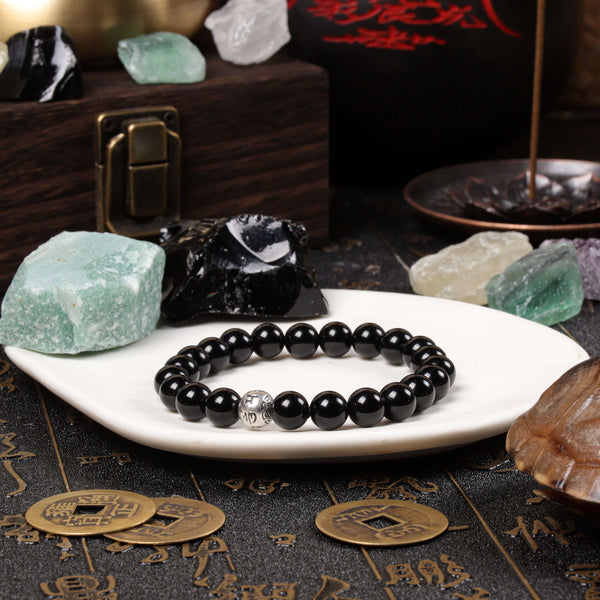
Beaded bracelets place smooth, polished spheres directly against the inner wrist meridians.
Best Uses: Daily desk work, prolonged typing, and daily commutes where sensory overstimulation is common.
Style & Selection Tip: Look for beads displaying natural amber-brown color variations and internal light clarity rather than opaque, dyed black beads.
Smoky Quartz Necklaces & Pendants
Worn near the chest and throat, a smoky quartz drop necklace anchors personal poise during collaborative meetings and open conversations.
Smoky Quartz Rings
A ring brings the stone's stabilizing presence to your hands as you write, create, and work.
Setting Recommendation: A protective bezel setting surrounds the stone's perimeter with metal, guarding the facet edges against accidental knocks during an active lifestyle.
Care Routine: Cleanse with lukewarm water, mild soap, and a soft-bristled brush; avoid harsh ultrasonic jewelry cleaners.

How to Cleanse Smoky Quartz and Keep It Charged
Recommended Cleansing Techniques
Moonlight Bathing (Most Recommended): Place your crystal along an interior windowsill under the soft light of the full or waxing moon. Cool moonlight thoroughly refreshes the stone's energetic clarity without risking UV-related color degradation.
Selenite Charging Slab (Safest & Most Convenient): Rest your jewelry directly upon a polished plate of selenite for 6 to 12 hours. This dry method causes zero wear on metal settings.
Aromatic Botanical Smoke: Pass your stone through the gentle smoke of dried sage, sweetgrass, or palo santo for 30 to 60 seconds while setting an intention of renewal.
Cool Flowing Water (Short Duration): Rinse the stone under lukewarm or cool running tap water for 30 to 60 seconds. Immediately pat completely dry with a soft microfiber cloth. Avoid hot water, and never soak set jewelry for extended periods.
Dry Sea Salt Bed: Place the stone on a clean cloth resting over a bowl of dry sea salt for 6 to 8 hours to draw out stagnant energy.
Essential Care & Preservation Warnings
Avoid Prolonged Direct Sunlight: Long-term exposure to intense ultraviolet light can destabilize radiation-induced color centers, gradually bleaching rich cognac stones into pale gray.
Avoid Aggressive Chemicals: Household cleaners, chlorine, and harsh detergents can erode surface polish and weaken jewelry settings over time.
Maintenance Schedule
Daily Wearers: Cleanse once weekly using moonlight or selenite plates.
Meditation & Breathwork Stones: Clear directly following intensive somatic or emotional release sessions.
Monthly Recharging: Place outside or on a window ledge overnight during the monthly full moon.
Frequently Asked Questions (FAQ)
What is smoky quartz good for?
Smoky quartz is primarily used for grounding awareness, soothing acute daily stress, relieving mental clutter, and supporting emotional stability. It provides a steadying tactile presence that helps you remain focused under pressure.
What does smoky quartz do spiritually?
It absorbs chaotic environmental static and anchors scattered attention back into physical equilibrium. It encourages realistic thinking, emotional resilience, and steady mindfulness.
What color is smoky quartz?
Smoky quartz spans subtle champagne-gray, warm amber-brown, rich cognac, deep chocolate, and opaque black (Morion). Natural specimens feature warm undertones and natural color zoning under transmitted light.
What is smoky quartz?
Smoky quartz is a macrocrystalline variety of quartz (SiO₂) whose distinctive earthy color is produced by natural geothermal irradiation acting upon trace aluminum impurities within its crystal lattice over geological epochs.
How much is smoky quartz worth?
Raw collector specimens and standard tumbled palm stones typically cost between $5 and $20. Fine jewelry-grade faceted gems featuring custom cuts, exceptional clarity, and untreated cognac coloring range from $40 to several hundred dollars depending on carat size and craftsmanship.
Is smoky quartz rare?
While macrocrystalline quartz is common globally, flawless, high-clarity natural crystals that have acquired their deep coloration purely through underground natural irradiation without laboratory enhancement are comparatively scarce.
How to tell if smoky quartz is real?
Authentic smoky quartz remains cold against the skin, shows subtle natural color zoning, and displays microscopic mineral veils or growth lines. Molded glass imitations often feel light, warm rapidly in the hand, and contain round air bubbles.
Is smoky quartz expensive?
Smoky quartz remains one of the most accessible and affordable fine gemstones on the market, offering exceptional durability, brilliance, and aesthetic warmth without the prohibitive cost of rarer precious gems.
Is smoky quartz natural?
Yes, genuine smoky quartz forms naturally within granitic and pegmatitic veins over millions of years. However, consumers should note that a significant portion of inexpensive, pitch-black quartz on the market has been artificially darkened using laboratory irradiation.
How to cleanse smoky quartz?
Cleanse your stone safely by bathing it in overnight moonlight, resting it on a selenite charging slab for 6 to 12 hours, passing it through aromatic herbal smoke, or rinsing it briefly under cool running water.
Can smoky quartz go in water?
Yes, brief rinses in cool, clean water are completely safe due to its high Mohs hardness of 7.0. However, avoid prolonged soaking (over 4 hours) or immersion in salty water, which can damage internal fissures or loosen jewelry mountings.
Can smoky quartz be in the sun?
Smoky quartz should not be left in strong, direct sunlight for extended periods. Intense ultraviolet radiation and excessive heat can cause its delicate color centers to destabilize, gradually fading its smoky hue.
How to charge smoky quartz?
Re-energize your stone by placing it under the light of a full moon, resting it upon a selenite slab, using sound vibrations from a singing bowl, or holding the crystal while silently affirming a grounded intention.
Can you wear smoky quartz everyday?
Yes. With a Mohs hardness of 7.0, smoky quartz resists everyday scuffs and scratches, making it durable enough for daily rings, bracelets, and pendants.
How often should I cleanse smoky quartz?
If worn daily or kept in an active workspace, cleanse your stone once per week. For occasional meditation use, clearing it once a month under the full moon is ideal.
What chakra is smoky quartz?
Smoky quartz is primarily aligned with the Root Chakra (Muladhara) at the base of the spine. It also bridges energy to the Crown Chakra (Sahasrara), creating an anchored flow between thoughtful reflection and physical stability.
What does smoky quartz represent?
Smoky quartz represents somatic grounding, quiet resilience, pragmatic wisdom, and the conscious transformation of daily tension into clear focus.
Is smoky quartz protective?
Yes, it is traditionally regarded as one of the most reliable protective stones, recognized for absorbing negative tension and fostering an environment of calm focus.
What crystals go well with smoky quartz?
It pairs seamlessly with selenite (for gentle purification), black obsidian (for a protective boundary), rose quartz (for grounded emotional balance), amazonite (for composed communication), and amethyst (for balanced crown-to-root flow).