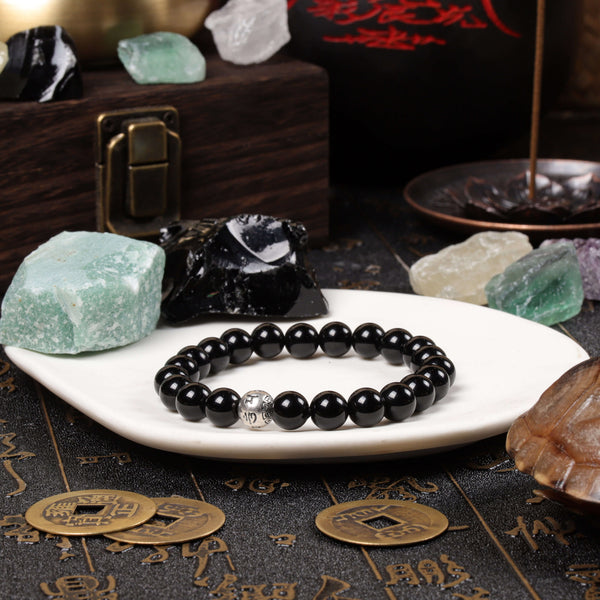
The Ultimate Black Obsidian Review: Exploring Raw Mineral Science, Historical Knives, and Modern Color Design
TABLE OF CONTENTS
When people encounter a black obsidian rock, their minds frequently leap to contemporary spiritual trends—energy fields, chakra alignments, or esoteric scrying rituals. However, through the lenses of mineralogists, historians, and industrial designers, this lustrous volcanic glass tells a far more visceral story. It is an epic born from the most violent thermodynamic eruptions of the Earth's crust, yielding a material so structurally unique that it actively carved the trajectory of early human civilization.

Born from Fire: The Violent Geology of Black Obsidian
To truly understand this material, we must correct a fundamental misconception: black obsidian is not a true mineral. In geological classification, it is an amorphous volcanic glass. This rock is forged from highly viscous, silica-rich rhyolitic lava (typically containing over 70% silicon dioxide). When this magma breaches the Earth's surface and undergoes rapid cooling upon contact with air or water, a fascinating structural phenomenon occurs. The temperature drops so quickly that the constituent atoms lack the time required to organize into a structured, geometric crystalline matrix. Instead, the liquid state is instantly "frozen" into an amorphous, chaotic solid. This lack of crystalline grain boundaries is the exact scientific reason behind its iconic glass-like luster and signature conchoidal fractures—the smoothly curved, shell-like surfaces that appear when the material is cleaved.
Another widespread consumer question is: is obsidian black? While a deep, uniform dark tone is the most prevalent expression found in nature, pure black is only one variation of this volcanic phenomenon. Depending on the specific micro-inclusions trapped within the cooling mass, several striking visual variants emerge:
Snowflake Obsidian: This pattern occurs when the glass undergoes partial devitrification over long epochs. Tiny, white, radially clustered mineral groupings of cristobalite form within the dark glass, creating a striking aesthetic that resembles falling snow.
Rainbow Obsidian: Nanometer-scale layers of magnetite or hematite micro-crystals create a thin-film interference effect. When exposed to a direct light source, the surface reveals mesmerizing, multi-colored concentric bands of iridescence.
Mahogany Obsidian: High concentrations of oxidized iron or goethite create deep, swirling reddish-brown ribbons that interlace with the dark matrix.
In mainstream industrial design, however, obsidian black color represents something far more singular: a dense, rich, near-absolute dark tone that absorbs light with remarkable sophistication. Nature occasionally introduces unexpected structural variations, but the classic expression remains the ultimate standard of depth.
The Edge That Built Civilizations: Obsidian as a Historical Tool
While modern high-precision engineering can hone specialized steel scalpels to remarkable precision, natural volcanic glass achieves a cutting edge that is sharpened at the atomic scale. Because obsidian completely lacks a crystalline grain structure, its cleaved edge does not suffer from microscopic jaggedness. When properly flaked, an obsidian edge can taper down to a thickness of mere molecules—approaching a width of roughly 3 nm. Under an electron microscope, even the most finely honed modern surgical steel blades resemble a rough, serrated saw blade, whereas a freshly fractured obsidian edge remains continuously, flawlessly smooth.
Because of this unique physical advantage, archaeological records of prehistoric tools span across every major continent. During the Mesopotamian Ubaid period (circa 6500–3800 BCE), expertly crafted projectile points were highly prized commodities traded across vast networks. Across the East African Rift Valley, Paleolithic populations relied on local deposits to strike uniform bladelets, which were immediately lashed to wooden shafts to serve as highly efficient harvesting sickles or defensive daggers.
The absolute pinnacle of this material's historic weapon engineering belongs to Mesoamerica. Aztec warriors commanded the battlefield with a legendary weapon known as the Macuahuitl—a flat, heavy wooden paddle inset along its flanks with row upon row of razor-sharp black obsidian arrowhead fragments and prismatic blades. Spanish conquistadors documented that a single focused blow from this weapon was capable of decapitating a warhorse. While early military records occasionally leaned toward dramatic literary exaggeration, modern ballistic reconstructions have verified a striking material fact: the slicing velocity of these historical black obsidian knives against soft tissue actively outperforms contemporary iron alloys of equivalent thickness.
This incredible shearing efficiency eventually caught the attention of modern medicine. In the 1970s, legendary archeological replication expert Don Crabtree pioneered the production of obsidian surgical scalpels. Subsequent medical trials in plastic and cardiovascular surgery demonstrated that incisions made with volcanic glass resulted in significantly less surrounding tissue trauma, cleaner cellular margins, and noticeably reduced scar tissue formation. While the supreme brittleness of the material and the cost-efficiency of disposable steel have kept it out of mass-production medical kits, it remains an undeniable scientific truth: a raw chunk of volcanic glass yields one of the sharpest cutting edges ever commanded by human hands.
The Dark Mirror: A Portal to the Past, Not Prophecy
When volcanic glass is meticulously polished, it yields a remarkably distinctive, deep reflection characterized by a subtle vitreous sheen. Unlike modern silvered mirrors, which reflect roughly 95% of incident light, a black obsidian mirror possesses a much lower reflectance curve. Because of the dense internal iron and magnesium pigments, the reflected image is cast in a moody, low-contrast, highly dramatic tone. This striking optical property is precisely why historic civilizations viewed these polished surfaces as windows into a deeper, parallel reality.
When we set aside modern commercial spiritual narratives, the documented historical provenance of the black obsidian scrying mirror is profoundly captivating:
The Court of Elizabeth I: The British Museum houses a world-famous polished obsidian mirror that once belonged to the legendary royal polymath, mathematician, and astronomer Dr. John Dee. Historical analysis confirms this artifact was carried to Europe following the Spanish conquest of the Aztec Empire. Dr. Dee—operating within the accepted natural philosophy parameters of the 16th century—utilized this precise mirror as a tool to explore the invisible realms of nature, positioning it as an ultimate symbol of intellectual and courtly prestige.
Elite Mesoamerican Regalia: Within the ancient ruins of Teotihuacan and classic Maya centers, archaeologists frequently unearth beautifully polished obsidian discs. These pieces were often drilled and worn as elite pectoral ornaments or woven into complex headpieces worn exclusively by the ruling class to project supreme power and cosmic authority.
Early Optical Innovation: During the 18th century, European optical pioneers utilized highly polished obsidian surfaces to study the behavior of polarized light. The internal structural stress patterns within the natural volcanic glass allowed it to function as a primitive polarizing filter long before the invention of commercial synthetic alternatives.
From a practical production standpoint, transforming a raw block into a flawless black obsidian sphere or flat mirror plane is an incredibly demanding lapidary task. Possessing a Mohs hardness of 5–5.5, it is slightly softer than hardened window glass but carries immense structural brittleness. Artisans must use progressively finer diamond-grit wheels while maintaining continuous water cooling, as local friction-induced thermal shock can instantly shatter the internal matrix of the piece. The final mirror finish requires meticulous polishing with cerium oxide compounds to achieve a state completely devoid of microscopic pitting.
Nature’s Palette: ‘Obsidian Black’ in Design and Industry
Modern consumer electronics, automotive design houses, and architectural firms have integrated this volcanic namesake directly into their high-end aesthetic palettes. Today, obsidian black paint and its digital counterparts operate as an established shorthand for luxury and technical precision.
Consider these notable industry examples:
Premium Tech Enclosures: In premium hardware design, select chassis models feature a distinct obsidian black color option. Rather than utilizing a flat, generic matte black plastic finish, manufacturers deploy premium anodized aluminum coatings embedded with micro-metallic particles to mimic the reflective depth and cold tactile quality of natural volcanic glass.
Automotive Exterior Finishes: Luxury automotive manufacturers frequently offer a premium obsidian black metallic paint option across their flagship fleets. This advanced automotive coating integrates fine aluminum flakes or coated mica particles within a deep black basecoat. Under direct sunlight, the finish transitions beautifully from an absolute dark tone into a rich, three-dimensional charcoal sheen with subtle blue-green undertones, replicating the sophisticated optical depth of premium obsidian specimens.
In professional design terminology, why does the industry continuously specify "Obsidian" rather than standard black? Pure digital black (HEX #000000) is visually flat and completely absorbs incident light, offering zero perceived structural depth. Conversely, the true obsidian black design concept operates within a strict HEX range of #0A0A0A to #1A1A1A. It introduces a lustrous, low-saturation cold undertone that creates a distinct perception of sub-surface reflectivity and multi-layered luxury.
In high-end architectural design, this tone is frequently utilized for minimalist statement walls, custom kitchen surfaces, and luxury accent installations. Unlike the organic veining of marble or the coarse grain of granite, natural or engineered obsidian surfaces project a sleek, vitreous coldness. It serves as an exceptional visual counterweight when paired with warm hardwoods or satin brass fixtures, generating a highly sophisticated architectural contrast.

From the Earth to the Artisan: The Crafting of Obsidian Objects
Transforming a rugged, sharp-edged chunk of raw black obsidian into a smooth, geometrically perfect black obsidian sphere, a stylized black obsidian cat, or a meticulously proportioned black obsidian heart is an exercise in the demanding art of reductive lapidary engineering.
The production sequence follows four traditional phases:
Material Selection and Percussion Cleaving: The lapidary artisan carefully inspects the raw block for internal stress fractures or air pockets. Utilizing the rock's natural conchoidal fracture patterns, the craftsman uses precise strikes with specialized soft-hammer tools to remove large exterior waste fragments, bringing the raw material close to the intended rough shape.
Coarse Mechanical Grinding: The material is moved to high-speed diamond grinding wheels, ranging from 60 to 120 grit, under a continuous stream of water coolant. This phase carries intense risk; due to the material's low fracture toughness, any excessive localized pressure or temperature spike will cause the piece to instantly fracture.
Progressive Refining: The artisan transitions the object through a sequence of increasingly fine abrasives (240, 400, 800, and 1200 grit). Each progressive step must completely erase the micro-scratches left by the previous phase, requiring absolute physical cleanliness between wheel changes.
Vitreous High-Polish: The final mirror finish is achieved on specialized felt wheels saturated with sub-micron cerium oxide or diamond polishing slurries. Because deep dark surfaces reveal even the slightest physical imperfections, any remaining microscopic flaw will instantly show up as a hazy gray blemish against the deep, glass-like background.
This meticulous processing highlights a beautiful aesthetic contrast within the material. In its unrefined state, raw volcanic glass retains its jagged, untamed edges—ideal for integration as a dramatic black obsidian landscape rock in minimalist exterior designs. Once polished by an expert artisan, however, it transforms into a fluid, light-catching masterpiece that invites tactile interaction.
Comparative Material Science: Obsidian vs. The Look-alikes
The global marketplace contains numerous dark materials that are frequently confused with one another. To maintain absolute professional accuracy, we must evaluate these substances strictly through objective material science metrics, without reliance on tables:
Black Obsidian: This material consists of an amorphous silica glass with a completely non-crystalline matrix. It registers between 5.0 and 5.5 on the Mohs hardness scale and exhibits perfectly conchoidal fracturing. Its primary optical signature is a distinct vitreous to sub-metallic luster, remaining uniquely translucent along microscopic sheared edges.
Black Onyx: Classified as a true cryptocrystalline quartz (), it delivers a higher Mohs hardness rating of 6.5 to 7.0. It displays a conchoidal to splintery fracture path and a characteristic waxy luster. Unlike natural volcanic glass, it is uniformly opaque and entirely lacks internal gas flow lines or natural inclusions.
Black Tourmaline: Structurally defined as a complex borosilicate crystal system, it possesses a high Mohs hardness of 7.0 to 7.5. It exhibits an uneven to sub-conchoidal fracture pattern and a strong vitreous luster, distinguished by striking vertical striations along its natural crystal faces.
Industrial Black Glass: This is a synthetically manufactured soda-lime or borosilicate material with a Mohs hardness of 5.5 to 6.0. While it mimics obsidian's conchoidal fracturing behavior, it is entirely uniform under magnification, lacking the rich geological fingerprint of native micro-mineral inclusions.
Obsidian Style Color Designations: This commercial shorthand refers entirely to synthetic textile nomenclature rather than a physical geological material. It represents a highly sophisticated, cold-toned charcoal variant popular in high-end athletic collections, delivering superior visual styling options compared to a flat, uninspired solid black fabric dye.
Understanding the precise differences between black onyx vs obsidian reveals that Onyx possesses a rigid crystalline layout that lacks the fluid, natural flow patterns native to genuine volcanic glass. Furthermore, when analyzing black obsidian vs black tourmaline, Tourmaline features a much higher hardness rating and exhibits distinct elongated crystal structures that are completely different from obsidian's smooth, isotropic glass format. Similarly, commercial fashion references—such as the iconic obsidian vs black lululemon palette selections—are purely aesthetic design designations.
Preservation and Care: The Physical Maintenance of Obsidian
To guarantee the long-term structural integrity and surface finish of a high-value volcanic glass asset, you must implement a care protocol rooted strictly in materials science.
Avoiding Mechanical Impact
Because obsidian possesses an amorphous glass architecture, its natural structural impact resistance is rated as low. Particle forces cannot easily absorb sudden kinetic shock. A drop onto stone flooring or a sharp impact against a hard counter will result in immediate fracturing or edge chipping. Always display your pieces on secured, padded platforms.
Preventing Thermal Shock
Never expose your volcanic glass items to extreme temperature differentials. Storing a piece in direct, unshaded sunlight can lead to localized heat buildup. If a hot stone is suddenly subjected to cold water or rapid air conditioning cycles, the sudden thermal contraction can trigger microscopic surface cracking. Maintain your collection within a stable temperature environment, and be cautious of leaving items exposed to intense black obsidian in sunlight conditions for extended durations.
Scientific Cleansing Protocols
When addressing the question of how to cleanse your piece safely without risking surface degradation, completely avoid any harsh industrial chemical solvents, ultrasonic jewelry cleaners, or abrasive polishing cloths.
First, prepare a solution of lukewarm distilled water mixed with a few drops of a pH-neutral, surfactant-free liquid soap. Gently wipe the surface using a clean, non-abrasive microfiber cloth to remove dust or skin oils. Rinse thoroughly with clean distilled water to prevent mineral spotting, and dry the asset immediately with a fresh, soft cloth. Store your obsidian items in independent soft fabric pouches to completely eliminate any risk of accidental scratching from harder stones like quartz or diamonds.
Geographic Treasures: Notable Sources and Their Unique Traits
Natural obsidian deposits are globally distributed along active or historic tectonic plate boundaries and volcanic rifts. The local trace geochemistry of each specific volcanic event dictates the unique internal visual signature of the extracted material:
The American West (Yellowstone Plateau): Formed by a massive supervolcano producing late Pleistocene rhyolite lava flows, this premier locality yields vast quantities of natural black obsidian. The material extracted here exhibits exceptional density and occurs in pure black, rainbow, and mahogany variants. It includes the historic Obsidian Cliff, which served as a monumental regional quarry site that fueled early human stone-tool economies for thousands of years.
The Pachuca Region (Hidalgo, Mexico): Situated along a Neogene volcanic arc, this world-famous locality produces an exceptional high-luster variety displaying magnificent golden and green iridescence. Historically, the Pachuca mines served as the primary obsidian source for the Aztec state to manufacture high-prestige ritual mirrors and elite state weapons.
The Volcanic Rifts of Iceland: Set directly along the subaerially exposed segments of the active Mid-Atlantic Ridge, the local extractions are predominantly black, often accompanied by rough gray patches and vesicular volcanic slag.
The Volcanic Fields of Armenia: Positioned over a Holocene volcanic belt, this locality yields material rich in vesicular cavities and microscopic crystalline inclusions. The extractions from Mount Saralin are highly coveted for their unique, lustrous silver-green sheen.
The Volcanic Formations of Kenya: Located within the East African Rift Valley, this region yields predominantly black glass with distinct reddish-brown ribbons, famously found at the Paleolithic tool factory ruins of the Kariandusi site.
In contemporary landscape architecture, large-scale, unrefined specimens are highly valued as a dramatic black obsidian landscape rock installation choice. When integrated within high-end hardscaping projects, these substantial volcanic boulders deliver an incredible visual contrast. Their unique glass surfaces react dynamically to rainfall, taking on a deep, lustrous quality that beautifully complements minimalist architectural greenery.
Conclusion: The Enduring Allure of a Volcanic Legacy
Natural volcanic glass requires no mystical exaggeration to command absolute fascination. It is an extraordinary material born within the intense heat of a volcanic conduit, frozen in a state of atomic fluidity, and wielded by humanity across millennia as both a lethal weapon and a sophisticated mirror. From the deep trenches of materials science to the refined showrooms of modern industrial design, this volcanic legacy continues to inspire through its unique combination of absolute sharpness and deep visual depth.
While science marvels at its atomic edge, traditional Eastern lineages have long utilized this same physical density to anchor spatial focus. Explore how our master-calibrated collection blends this violent geology with mindful alignment to bring a profound sense of clarity and unyielding stability to your daily environment.

Hard-Science Frequently Asked Questions (FAQ)
Q1: Is pure black obsidian always completely opaque under direct light?
A: No. If you hold an authentic specimen up to a powerful, concentrated light source, the very thin sheared edges of the volcanic glass will invariably reveal themselves to be slightly translucent, displaying a smoky gray, greenish, or yellowish-brown undertone. If a dark, stone-like object remains entirely opaque even on a razor-thin fractured edge, it is highly likely a different mineral form, such as cryptocrystalline onyx.
Q2: Can an obsidian fracture edge genuinely exceed the sharpness of surgical-grade stainless steel?
A: Yes. High-quality obsidian can be flaked down to a cutting edge that measures approximately 3 nm in thickness, which is significantly sharper than standard medical-grade stainless steel blades that typically taper to 30–50 nm. Because obsidian lacks a crystalline grain structure to create microscopic roughness, it cleaves tissue cleanly rather than tearing it. However, steel remains the global medical standard due to its vastly superior structural flexibility and resistance to accidental shearing or snapping during operation.
Q3: Why does a freshly sheared fracture in raw obsidian occasionally resemble industrial plastic or commercial glass?
A: Because obsidian is structurally a completely natural form of glass. Its non-crystalline, amorphous internal architecture reacts to physical fracturing in the exact same manner as synthetic manufactured glass or high-density polymers, yielding the identical highly polished, curved conchoidal paths and sharp glassy ridges that define vitreous materials.
Q4: What are the definitive structural differences between natural volcanic obsidian and regular factory-manufactured black glass?
A: The defining differences are revealed through microscopic and chemical analysis. Man-made black glass is chemically uniform and virtually flawless. In contrast, natural obsidian contains a complex geological thumbprint, including trace percentages of native water, microscopic gas bubbles elongated by ancient lava flows, and embryonic mineral crystal needles known as crystallites or microlites.
Q5: Where are the Earth's largest, most significant natural black obsidian deposits geologically located?
A: The most massive, historically significant geological formations are located at the Obsidian Cliff within Yellowstone National Park in the United States, and across the rugged volcanic fields of Pachuca in Hidalgo, Mexico. Both locations served as monumental regional quarry sites that fueled early human stone-tool economies for thousands of years.
Q6: Why has "Obsidian Black" emerged as a dominant color choice for premium performance cars and elite tech hardware?
A: Unlike flat, standard black paint formulations that absorb light uniformly and can occasionally look visually flat or inexpensive, an obsidian-inspired finish replicates the natural, multi-layered depth of volcanic glass. By incorporating specialized metallic or mica layers, these premium industrial coatings interact dynamically with ambient light, beautifully tracking the complex contours of high-end vehicle bodywork and performance tech hardware.