
Amethyst Healing Properties: Meaning, Science, and Spiritual Lore
TABLE OF CONTENTS
- Primary Benefits of Amethyst in Daily Practice
- Does Amethyst Have Healing Properties? Science vs. Belief
- Metaphysical and Physical Properties of Amethyst
- What Healing Properties Does Amethyst Have in Spiritual Practices?
- Daily Care Guide: How to Cleanse, Recharge, and Wear Amethyst
- Frequently Asked Questions About Amethyst
Quick Summary: What Is Amethyst Good For?
In holistic and mindfulness traditions, amethyst is used as a tactile anchor to support emotional calm, mental focus, restful sleep, and intentional boundaries. It is not an active medical treatment; its benefits stem from subjective ritual, color psychology, and sensory mindfulness.
Emotional Balance: Relieves daily overstimulation by offering a physical cue to pause, breathe, and think clearly.
Sleep Rituals: Placed beside the bed to signal the mind to unplug from evening screen time and racing thoughts.
Meditative Focus: Associated with the Third Eye and Crown chakras to anchor deep breathing and present-moment awareness.
Energetic Boundaries: Used symbolically by sensitive individuals as a boundary marker to deflect ambient emotional stress.

Primary Benefits of Amethyst in Daily Practice
Throughout holistic wellness communities, amethyst is cherished as an everyday companion stone. Rather than offering measurable biological interventions, its value lies in mindful rituals, sensory connection, and timeless cultural heritage.
Emotional Equilibrium and Sober Mental Clarity
Throughout Western history, amethyst has been honored as the Stone of Sobriety. Within modern crystal traditions, it is used to quiet an overstimulated nervous system, helping people step back from anger, worry, and reactive habits to recover mental clarity.
This symbolism originates from the ancient Greek root word amethystos (“not intoxicated”). The ancients wore it believing it guarded the mind against cloudy judgment. In modern mindful practice, this property serves as a grounding cue: when stress rises, holding a smooth stone prompts a conscious pause to choose clarity over impulse. It is an intentional self-regulation tool, not a clinical treatment for anxiety or mood disorders.
Restful Sleep, Evening Unwinding, and Dream Recall
Keeping a raw cluster or polished stone on a bedside table is among the most popular rituals in crystal culture. Many find that having this soothing stone nearby creates an environmental trigger to power down devices, clear mental clutter, and ease into restorative sleep.
In esoteric lore, amethyst is also tied to dream work and intuitive recall. Some practitioners place it beside their pillow during evening meditation to set an intention for peaceful, reflective rest.
Practical Care Tip: Keep your crystal on a sturdy nightstand rather than under your pillow to avoid accidental damage or discomfort. Keep natural amethyst away from direct, harsh sunlight, as prolonged ultraviolet radiation causes natural violet tones to fade over time.
Intuitive Focus and Mindful Anchoring
Within traditional chakra maps, amethyst corresponds to the Third Eye (Ajna) and the Crown (Sahasrara) energy centers, making it a natural choice for quiet reflection and creative brainstorming.
When used during meditation, amethyst serves as a wearable energy anchor—a physical object that centers attention. Whenever your mind wanders during the day, touching the cool, smooth surface of your crystal gently guides your focus back to the present moment.
Energetic Boundaries for Sensitive Individuals
Holistic practitioners often describe amethyst as an energetic buffer stone, making it popular among highly sensitive people (HSPs) and empathetic caregivers.
Symbolically, it acts as a personal boundary keeper: a visual reminder to separate your own feelings from the emotional noise of people around you. Keeping this intention alive helps protect personal energy from everyday burnout.
Setting Realistic Expectations
The true value of amethyst lies in natural beauty, centuries of craftsmanship, psychological ritual, and mindful presence. It cannot magically deliver sudden wealth, resolve relationship conflicts, guarantee passing grades, or cure health conditions. Choosing amethyst for its quiet elegance and personal meaning—free from exaggerated marketing claims—is the most grounded way to bring it into your life.

Does Amethyst Have Healing Properties? Science vs. Belief
In academic science and clinical medicine, crystal healing is classified as an alternative, non-empirical practice. It does not possess clinical validation under randomized testing standards. Yet, as a personal ritual and cultural tradition, it continues to inspire millions worldwide. Balancing scientific evidence with personal belief is key to enjoying crystals safely.
The Modern Philosophy of Crystal Healing
Crystal healing rests on the metaphysical premise that mineral structures emit subtle vibrational patterns that interact with human energy fields. Originating in ancient talismanic rites, this belief has grown into a widespread lifestyle movement centered on mindful jewelry, desktop stones, and home decor.
Mainstream physical sciences categorize these claims as unsupported by clinical data because energetic resonance cannot be measured or repeated under laboratory conditions.
Scientific Insights: Placebo, Conditioning, and Recent Research
Clinical research has explored why crystal enthusiasts frequently report genuine boosts in well-being:
The 2025 Cambridge University Trial (CNS Spectrums): A randomized controlled trial of 138 adults evaluated the psychological impact of genuine crystals against visually identical placebos across both believers and skeptics. The findings revealed that reductions in self-reported anxiety occurred exclusively among individuals who already believed crystals worked. Crucially, improvements did not differ between those holding real crystals and those holding placebos. Bayesian analysis supported the null hypothesis of no specific mineral-driven therapeutic effect.
The 2025 Double-Blind Amethyst Trial: A four-week double-blind, placebo-controlled study with 38 participants found that neither natural amethyst nor synthetic lookalikes produced measurable physiological shifts in lifestyle metrics or self-rated health, even among participants who favored alternative wellness approaches.
The Scientific Takeaway: Amethyst does not heal through physical energy beams. Instead, focused intention, soothing rituals, and the placebo response create authentic psychological benefits. When you sit quietly with an amethyst, your nervous system responds to the deliberate atmosphere of peace you have built around yourself.
Furthermore, color psychology shows that balanced violet and indigo shades evoke natural feelings of tranquility, contemplation, and emotional ease.
Safe Sourcing and Marketplace Red Flags
To avoid exploitative commercial claims, watch for these common marketing traps:
Clear Red Flags: Sellers who claim a stone can cure serious illnesses, urge you to discontinue prescription treatments, guarantee financial windfalls, or use buzzwords like "quantum crystal power" without evidence.
Crystal Elixir Safety Warning: Never drink water infused with raw crystals. The International Gem Society (IGS) warns that rough minerals can contain toxic trace metals, matrix impurities, or abrasive polishing residues. Treat crystal elixirs solely as symbolic decorative concepts, never as beverages.

Metaphysical and Physical Properties of Amethyst
Appreciating amethyst begins with its geological structure before exploring its rich symbolic history.
| Dimension | Gemological Specification | Cultural & Metaphysical Meaning |
| Chemical Formula | Silicon Dioxide (SiO₂) | Earth's structured, orderly mineral network |
| Crystal System | Trigonal (prismatic crystal faces) | Balanced geometry and upward focus |
| Mohs Hardness | 7 (Durable for daily jewelry and carvings) | Resilient energy anchor built for regular wear |
| Color Origin | Iron (Fe³⁺) impurities with natural irradiation | Turning emotional strain into calm composure |
| Physical Optical Trait | Piezoelectric response under pressure | Symbol of holding and reinforcing steady intentions |
Mineralogical Facts: Chemistry, Color Centers, and Piezoelectricity
Amethyst is the violet crystalline variety of quartz. It forms in the trigonal crystal system, often displaying subtle horizontal growth striations along its prism faces. Its signature violet hue forms deep within the earth when trace iron (Fe³⁺) ions substitute for silicon atoms within the quartz structure and undergo exposure to natural background radiation, creating specialized color centers.
With a Mohs hardness of 7 and a refractive index of 1.544 to 1.553, amethyst resists scratching and wears comfortably every day. Like other quartz varieties, it exhibits piezoelectricity—the ability to generate an electric charge under mechanical stress.
Physics vs. Metaphysics: In science, piezoelectricity is a physical mechanism utilized in wristwatches, microphones, and sonar equipment. In holistic traditions, this trait is poetically viewed as a stone's capacity to "store and amplify intentions." Distinguishing between physical physics and poetic metaphor keeps our appreciation grounded and sincere.
Heat Sensitivity: When heated to temperatures between 240°C and 270°C (464°F and 518°F), the iron color centers degrade, causing the purple shade to fade into golden-yellow or amber tones—frequently sold on commercial markets as heat-treated citrine. This explains why fine natural amethyst must never be exposed to boiling water, steam rooms, or long hours of direct outdoor sun.
Historical Lineage: Greco-Roman Lore, Bishop's Rings, and Eastern Tradition
Amethyst has enjoyed high cultural status across global civilizations for thousands of years:
Greco-Roman Legend: Myth recounts that Bacchus (Dionysus), the god of wine and celebration, poured wine over a white quartz statue of a young maiden named Amethyst, dyeing the mineral purple and granting it the power to prevent intoxication and maintain balanced speech.
Ecclesiastical Regalia: In Christian tradition, amethyst became the dedicated jewel of bishops and cardinals. Known as the Bishop's Stone, its regal purple color symbolized spiritual devotion, humility, and protection from worldly distractions.
Eastern Wisdom and "Purple Qi": In traditional Eastern spatial practices, purple represents exceptional dignity, wisdom, and auspicious fortune, embodied in the timeless saying Purple Qi Arriving from the East (紫气东来)—an ancient idiom heralding the arrival of wise teachers and noble opportunities. Rather than simple ornament, amethyst clusters were historically positioned within libraries and studies to clear the mind and refine intellectual focus.
Authentication Guide: Natural vs. Synthetic Varieties
Both naturally mined and lab-grown hydrothermal amethysts share an identical chemical composition (SiO₂). However, mindful practitioners often prioritize naturally mined stones for their geological heritage:
Color Zoning: Natural amethyst almost always features uneven color distribution, showing subtle color bands, chevron angles, or darker tips.
Natural Inclusions: Authentic stones carry natural internal signatures, such as delicate feather veils, liquid inclusions, or microscopic fissures. Perfectly clear stones with unnaturally saturated color often indicate dyed glass or synthetic quartz.
Birefringence (Double Refraction): Placing an unmounted natural crystal over a fine strand of hair reveals a faint doubling of the line through specific optical angles, reflecting its anisotropic quartz crystal structure.
Geographic Varieties: Brazilian amethyst typically features soft lavender and lilac shades at budget-friendly prices, while fine material from Uruguay and Zambia is prized for saturated royal purple with rich blue-red flashes. Color depth reflects geological formation, not spiritual power—select the tone that appeals most to your personal taste.

What Healing Properties Does Amethyst Have in Spiritual Practices?
Within traditional chakra models and classical spatial curation, amethyst functions across emotional, mental, and spatial dimensions.
Chakra Alignment: Connecting the Third Eye and Crown
Amethyst holds a notable bridge position across the upper energy centers:
The Third Eye Chakra (Ajna): Positioned between the brows, governing intuition, pattern recognition, and intellectual clarity. Amethyst is used to clear mental fog so you can view challenges objectively.
The Crown Chakra (Sahasrara): Positioned at the top of the head, representing spiritual awareness and inner peace. Amethyst serves as an anchor, helping you translate quiet inspiration into structured daily habits.
Behavioral and Habitual Anchoring
While traditionally worn to discourage alcohol indulgence, modern mindfulness seekers use amethyst as a sensory pause button against impulse buying, emotional snacking, or digital burnout. Wearing an amethyst bracelet creates a tactile check-in: each time you reach out unconsciously, the weight of the cool stones offers a three-second window to ask, "Is this an intentional choice or a restless habit?"
Eastern Spatial Placement: Five Elements, Harmonization, and Period 9 Fire
In classical Eastern spatial curation, amethyst offers practical versatility for homes and executive spaces:
The Study and Career Sector (Wen Chang Desk Placement): Setting a natural cluster or polished sphere on the north or northeast area of your workspace encourages quiet concentration, creative writing, and mental endurance.
Softening Structural Overhead Beams (化梁压煞): In traditional home design, large exposed ceiling beams can create a subconscious feeling of physical pressure. Positioning an amethyst geode below the beam softens the visual weight and anchors the space.
Central Living Room Core (Tai Chi Center): A natural geode placed centrally fosters respectful communication and emotional balance throughout shared living areas.
Celebration and Reputation Sectors (Period 9 Fire Alignment):
In traditional Three Yuan Nine Yun metaphysics, the current era is Period 9 (2024–2043), ruled by the transformative energy of the Nine Purple Fire Star (九紫离火). As we move through 2026—the dynamic third year of this twenty-year cycle—amethyst is widely appreciated for its energetic affinity with Fire energy. In spatial layout, displaying an amethyst geode or an arrangement of nine crystals in the South or Southeast sectors is traditionally used to support creative influence, social recognition, and intuitive insight.
Crystal Pairings: Balancing Introspection with Action
To design a well-rounded crystal pairing for your home or jewelry, amethyst pairs naturally with these complementary stones:
Amethyst and Citrine (Ametrine Harmony): The quintessential union of serene wisdom and purposeful action. While amethyst keeps impulsive moves in check, warm golden citrine provides creative confidence, creating a balanced cycle of thought and execution.
Amethyst and Clear Quartz: Magnifies mental clarity and keeps home workspaces feeling fresh and organized.
Amethyst and Rose Quartz: Combines thoughtful boundaries with gentle compassion, softening self-critical inner talk.
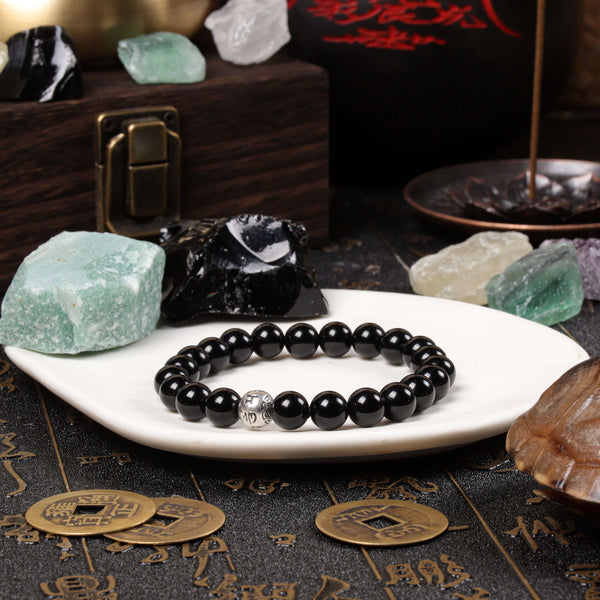
Amethyst and Black Obsidian: A dependable grounding duo. Obsidian grounds physical presence while amethyst settles racing thoughts.

Daily Care Guide: How to Cleanse, Recharge, and Wear Amethyst
In crystal lore, caring for your stone is treated as an intentional, meditative routine that keeps your jewelry clean and re-centers your personal goals.
Gentle Cleansing Methods
Soft Moonlight: Leave your amethyst on a clean windowsill during the full or waxing moon. This is the safest method for pieces set in silver, gold, or mixed-metal jewelry.
Clear Quartz Beds: Lay your amethyst bracelet on a natural clear quartz cluster or selenite plate for 24 hours to clear daily sensory dust.
Quick Cool Water Rinse: Rinse briefly under cool tap water to remove surface dust. Avoid salt water baths, as salt corrodes jewelry mountings, degrades elastic cords, and dulls mineral luster.
Wearing Conventions: The Left Wrist vs. Right Wrist
In traditional Eastern meridian and energy flow systems, circulation follows the principle of receiving on the left, releasing on the right (左进右出):
Left (Non-Dominant) Wrist: Wear here to absorb calm stillness, deepen study habits, and support restorative rest.
Right (Dominant) Wrist: Wear here when entering demanding work environments to project clear boundaries and avoid taking on ambient workplace stress.
From a practical perspective, wearing jewelry on your non-dominant hand also minimizes accidental bumps and scratches throughout the day.

Frequently Asked Questions About Amethyst
Does amethyst need to be cleansed? How often?
Cleansing is a mindful ritual rather than a physical requirement; natural quartz does not absorb measurable negative energy. In personal practice, cleansing your stone every four to six weeks is a good rhythm. Use gentle overnight moonlight or place it on a clear quartz cluster for a day. Avoid harsh salt baths and prolonged midday sun.
Are natural and synthetic amethysts equally effective?
From a chemical perspective, both are silicon dioxide (SiO₂). If your priority is color therapy or daily jewelry, synthetic crystal works very well. For traditional mindfulness practices, naturally mined stones are preferred because their microscopic growth patterns and natural formation carry an authentic connection to the earth.
Can everyone wear amethyst every day?
Yes, it is versatile and comfortable for almost everyone. However, if you are struggling with severe procrastination or fatigue, wearing calming amethyst by itself might encourage passive overthinking. Balance it with warm, action-oriented stones like citrine, red agate, or carnelian.
Why does an amethyst change color or turn yellow?
When natural amethyst experiences sustained temperatures above 240°C (464°F) or months of intense ultraviolet sunlight, its iron color centers destabilize, causing the purple tint to fade into yellow or pale white. This is a natural physical reaction. Always remove your jewelry before using saunas, taking hot showers, or sunbathing.
Can amethyst replace medical care for anxiety or insomnia?
No, absolutely not. Amethyst is a mindful design element and a cultural companion stone. It has no clinical capacity to treat or resolve mental health conditions, clinical depression, or physical illness. Always consult a licensed medical professional for chronic symptoms.
Is it safe to keep amethyst in the bedroom?
Yes. It makes a beautiful addition to a restful nightstand. Keep it on a bedside table rather than under your pillow to protect both the crystal and yourself from accidental injury.
What are the best crystals to combine with amethyst?
The most popular combinations include citrine (balancing calm thought with driven execution), clear quartz (enhancing clarity and space clearing), rose quartz (encouraging self-acceptance), and black obsidian (anchoring personal boundaries).
Can amethyst prevent alcohol intoxication?
No. This belief comes from ancient Greek mythology and the word amethystos. Amethyst cannot alter blood alcohol levels, speed up liver metabolism, or reduce the physical impact of alcohol. Never depend on a mineral for alcohol safety.
How do I spot deceptive claims when shopping for crystals?
Be cautious of sellers who claim a crystal can cure physical illnesses, suggest stopping doctor-prescribed medicine, guarantee sudden financial windfalls, or use scientific terms like "quantum frequencies" without proof. Trustworthy artisans celebrate crystals as grounding tools for mindfulness, not magical quick fixes.
Is it safe to drink amethyst-infused crystal water?
It is not recommended. While pure quartz is chemically stable, natural rough specimens often contain matrix impurities, raw heavy-metal residues, or chemical polishing agents that can contaminate water. Treat crystal elixirs purely as visual decorative displays, never as beverages.
The traditional healing properties of amethyst represent a thoughtful blend of geological wonder, cultural history, and conscious psychology. The true value of this violet stone does not come from invisible rays; it comes from its role as an objective mirror for intentional living.
When daily life feels noisy and demanding, catching sight of an amethyst on your wrist or desk provides an instant pause. It invites you to take a slow breath, re-establish personal boundaries, and return to quiet, dignified composure. Enjoy it for its timeless aesthetic and cultural heritage, keeping your actions grounded while your intentions remain clear.



Leave a comment