
Taoism vs Daoism: Is It a Religion or a Philosophy? The Modern Blueprint for Effortless Living
TABLE OF CONTENTS
- Taoism vs Daoism: Are Daoism and Taoism the Same Thing?
- Is Daoism a Religion or a Philosophy? Understanding Daojia vs Daojiao
- Is Daoism Monotheistic or Polytheistic?
- What Do Daoists Believe? Wu Wei, Yin Yang, and the Frictionless Mind
- Daoism vs Buddhism and Western Philosophy
- How to Practice Daoism in Daily Life: 3 Micro-Habits
- Is Feng Shui Part of Taoism? Aligning Your Space for Mental Calm
- Bringing Daoist Wisdom into Daily Life: Wearable Energy Anchors
- Frequently Asked Questions
Key Takeaway: Daoism and Taoism refer to the exact same ancient tradition; the difference is simply phonetic transliteration (modern Pinyin vs. older Wade-Giles). Daoism functions simultaneously as an insightful philosophy (Daojia) and an experiential, living tradition (Daojiao). It is neither a dogmatic religion demanding blind worship nor a cold academic theory. Instead, it is an operating system engineered to eliminate internal friction, conserve vital energy, and restore natural balance in daily life.
It is 2:00 AM. Your body is physically exhausted, yet your mind is running in fifth gear—replaying tense conversations, anticipating tomorrow's urgent notifications, and spiraling through digital noise. You feel like a high-tension cable stretched so tight that the slightest touch could snap it.
Over 2,600 years ago, an Eastern sage offered an exact equation engineered specifically to relieve that mental burden.
Recorded in Chapter 48 of the Tao Te Ching, the principle is deceptively simple:
"To pursue knowledge, gain something every day. To pursue the Tao, drop something every day."
The foundational gift of Daoism does not demand dogmatic belief, ritual conversion, or religious guilt. Instead, it offers an essential modern skill: the art of mindful subtraction and living without internal friction.
Before putting this wisdom into practice, one fundamental question must be answered: Is Daoism a religion or a philosophy?

Taoism vs Daoism: Are Daoism and Taoism the Same Thing?
Yes. Daoism and Taoism refer to the exact same ancient tradition. There is zero historical, philosophical, or spiritual difference between the two terms. The variation exists purely because Western scholars used two different systems to translate Chinese sounds into the Roman alphabet.
Taoism / Taoist (Wade-Giles System): Created in the 19th century by British scholars. While written with a "T", it was always meant to be pronounced with a soft "D" sound (rhyming with now).
Daoism / Daoist (Hanyu Pinyin System): Developed in the 20th century as the official international standard for Chinese phonetics. It uses a "D" to reflect how native speakers actually pronounce the word.
Taoist or Daoist: Which Spelling and Pronunciation Are Correct?
Both spellings are correct and refer to the exact same heritage. Whether you write taoist or daoist, taoism vs daoism, or daoist taoist, you are referencing the identical lineage of Laozi and Zhuangzi.
In contemporary academic literature and global translation standards, Daoism and Daoist are preferred for phonetic accuracy. However, Taoism and Taoist remain widely recognized in Western mindfulness and publishing.

Is Daoism a Religion or a Philosophy? Understanding Daojia vs Daojiao
Attempting to force Daoism into a strict "religion vs. philosophy" binary is an intellectual trap.
This division originated in 19th-century Western academia, when European scholars tried to fit holistic Eastern traditions into European categories. In classical Chinese thought, rigid distinctions between philosophy and lived spiritual practice never existed.
Renowned Sinologist Kristofer Schipper noted that splitting Daoism into "noble, secular philosophy" and "superstitious religion" reflects a Western misunderstanding. In authentic lineages, the tradition operates across two unified layers:
Daojia (The Philosophical School): The theoretical architecture, cosmology, and conceptual blueprint for understanding reality.
Daojiao (The Living Tradition): The experiential methods, lifestyle rituals, spatial sciences, and energetic practices that bring that blueprint into daily physical reality.
Separating Daoist philosophy from its lived practice is like separating the architectural blueprint of a home from the physical roof that keeps the rain off your head. Ancient lineages viewed wisdom not as an intellectual debate to argue, but as a kinetic discipline to embody.
Daojia vs Daojiao: Key Distinctions at a Glance
| Dimension | Daojia (Philosophy) | Daojiao (Living Tradition) |
| Primary Character | Philosophical inquiry and worldview | Institutionalized, experiential tradition |
| Foundational Figures | Laozi, Zhuangzi | Laozi (revered as ancestral master), Zhang Daoling |
| Core Objective | Cognitive freedom, self-mastery, mental peace | Holistic vitality, physical longevity, cosmic harmony |
| Core Methodology | Wu Wei (effortless action), Zuowang (sitting in stillness) | Internal alchemy (Neidan), breathwork, Feng Shui, rituals |
| Organizational Form | Open, non-institutional, personal inquiry | Lineages, practitioner collectives, traditional arts |
| Modern Application | Emotional regulation, stress reduction | Somatic wellness, environmental harmony, nervous system balance |
Daojia provides the root philosophy; Daojiao provides the living branches. The central anchor of both remains the formless Dao itself.

Is Daoism Monotheistic or Polytheistic?
Because Daoism developed independently of Western theological frameworks, neither "monotheistic" nor "polytheistic" accurately describes its structure.
Daoism is not Monotheistic: There is no omnipotent, anthropomorphic creator God who rules the universe from above, hands down moral commandments, or demands unquestioning worship. The Tao is not a divine person; it is the nameless, self-generating law that animates and balances reality.
Daoism is not Polytheistic in the Traditional Western Sense: While Daoist temples feature altars honoring historical masters, cosmic principles, and immortals, these figures are not external deities demanding fearful submission. They are energetic archetypes and personifications of universal virtues, elemental patterns, and human self-realization.
Daoism is best understood as an organic, holistic cosmology. Everything in the physical universe is made of the same primordial vitality (Qi). Spiritual growth is not about praying to an outside savior; it is about harmonizing your personal energy with the natural order of the cosmos.

What Do Daoists Believe? Wu Wei, Yin Yang, and the Frictionless Mind
Daoist principles are practical tools designed to help human beings navigate life without depleting their vital energy.
1. Wu Wei: Frictionless Action, Not Passive Inaction
The most common misunderstanding in the West is assuming Wu Wei means doing nothing, giving up, or becoming passive.
Wu Wei literally translates to non-contrived action—acting without friction, stubborn manipulation, or brute force.
Think of a seasoned surfer: they do not generate the ocean wave through sheer willpower; they read the water, align with its momentum, and ride it with balance and zero wasted motion. Wu Wei means withdrawing stubborn ego from situations you cannot control so you can direct clean, focused energy toward what actually works.
2. The Sacred Yin-Yang: The Law of Dynamic Balance
The classic Yin-Yang symbol illustrates three immutable laws of reality:
Inherent Interdependence: Inhale and exhale, action and rest, light and shadow exist only in relation to one another. Resisting periods of rest guarantees eventual collapse.
The Seed of Reversal: The white dot inside the dark swirl illustrates that every extreme state naturally contains the seed of its opposite. High-stress plateaus hold the opening for renewal; unchecked ego blindsides itself to vulnerability.
Dynamic Equilibrium: Balance is not a rigid, frozen state achieved once and kept forever; it is a fluid, moment-by-moment adjustment.

Daoism vs Buddhism and Western Philosophy
| Tradition | Foundational Premise | Ultimate Objective | Daily Practice Focus |
| Daoism | The world is an expression of the Tao; harmony comes from flowing with natural law. | Physical vitality, mental clarity, and thriving in this lifetime. | Wu Wei, breathwork, spatial harmony (Feng Shui), somatic grounding. |
| Buddhism | Life in the material world is impermanent and prone to suffering (Dukkha). | Liberation of consciousness from cyclic attachment (Nirvana). | Detachment, insight meditation (Vipassana), ego dissolution. |
| Stoicism | External events are indifferent; virtue lies in logical self-control (Logos). | Emotional endurance through disciplined reason and acceptance. | Cognitive reframing, emotional self-mastery, memento mori. |
Buddhism offers conscious detachment from life's turbulent fires; Daoism provides the energetic engineering to keep your home from catching fire in the first place, allowing you to drink your tea in peace.
How to Practice Daoism in Daily Life: 3 Micro-Habits
Integrating Daoist wisdom into a demanding modern schedule requires no monastic retreat—only targeted, micro-level intentionality.
Micro-Habit 1: Daily Subtraction
The Practice: Remove one unused, stagnant item from your living or work area today—an unworn piece of clothing, an unnecessary task from your calendar, or an draining obligation.
The Wisdom: As Chapter 48 reminds us, inner clarity begins with external subtraction. Physical clutter creates visual friction, taxing working memory and trapping stagnant ambient energy (Qi). Decluttering physical space sends an immediate signal to the nervous system to let go of tension.
Micro-Habit 2: The 3-Second "Ting Xi" Breath Anchor
The Practice: Before answering a stressful email, joining a high-stakes call, or reacting to a difficult message, pause for three seconds. Close your mouth and simply listen to the natural friction of air flowing through your nostrils without trying to change its pace.
The Wisdom: Adapted from the ancient practice of Ting Xi ("listening to the breath"), this three-second pause disengages sympathetic fight-or-flight reactivity, engages the vagus nerve, and anchors awareness in quiet observation (Zuowang).
Micro-Habit 3: The Way of Water
The Practice: In an escalating disagreement, catch the reflex to dominate through volume or stubbornness. Pause and ask yourself: "How would water handle this?"
The Wisdom: Water never attacks a boulder head-on; it yields, flows around the edge, and gradually shapes the stone. Yielding conversational tension is not weakness—it is an energetic pivot that preserves your cognitive resources.
Is Feng Shui Part of Taoism? Aligning Your Space for Mental Calm
Classical Feng Shui is an environmental science born directly out of Daoist cosmology. In authentic metaphysics, your physical surroundings and your internal state are two sides of the same coin.
Anchor Your Rest (Solid Wall Support): Ensure your bed headboard sits flush against a solid interior wall rather than floating in open space or resting beneath a drafty window. In environmental psychology, a solid backing calms the amygdala, signaling true safety and facilitating deep sleep.
Establish the Command Position at Work: Orient your work desk so you can see the room's entrance without sitting directly in line with the doorway. Sitting with your back exposed to open traffic keeps subconscious alert mechanisms firing, silently draining your focus.
Clear the Forward Horizon (Ming Tang): Keep the visual field immediately in front of your desk or primary resting spot open and uncluttered. Expansive sightlines stimulate creative executive thinking and prevent mental lethargy.

Bringing Daoist Wisdom into Daily Life: Wearable Energy Anchors
In authentic Eastern traditions, abstract philosophy is grounded through tangible, tactile reminders. When daily demands pull your attention in a dozen directions, having a physical touchstone helps draw your awareness back to stillness.
This is the intention behind HVibeTune's metaphysical accessories.
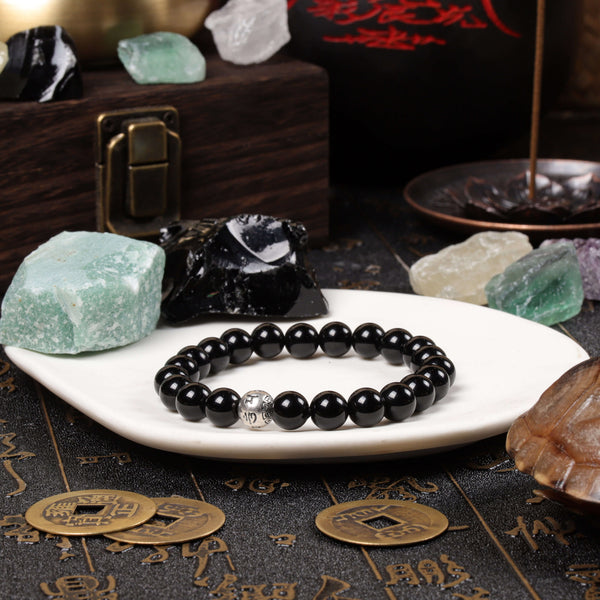
Rooted in centuries-old Eastern spatial and energetic heritage, these pieces are crafted using genuine, earth-born stones—such as protective Natural Black Obsidian, grounding Black Tourmaline, and centering Tiger's Eye. Each piece undergoes dedicated energetic alignment to honor natural elemental harmony:
Natural Black Obsidian: A natural volcanic glass traditionally used to clear stagnant energetic buildup and establish healthy emotional boundaries.
Black Tourmaline: Revered for grounding scattered mental energy and shielding personal space from environmental tension.
Tiger's Eye: A centering stone selected to foster calm discernment, steady courage, and balanced confidence under pressure.
These accessories are not magical shortcuts; they function as wearable energy anchors. Resting against your wrist throughout a demanding workday, the cool weight of natural stone serves as a physical prompt to take that three-second breath, release unnecessary tension, and return to the natural flow of the Tao.

Frequently Asked Questions
Are Daoism and Taoism the same thing?
Yes, they are identical. "Taoism" originates from the 19th-century Wade-Giles transliteration, while "Daoism" uses modern Hanyu Pinyin. Both refer to the exact same philosophical and spiritual tradition founded by Laozi.
Is Daoism a religion or a philosophy?
It is both. The philosophical framework (Daojia) provides the conceptual worldview, while the living tradition (Daojiao) provides somatic exercises, breathwork, spatial alignment, and rituals to embody that worldview.
Taoist or Daoist: Which spelling should I use?
Both are fully acceptable. "Daoist" is favored in modern linguistic and academic contexts because it matches official Pinyin standards, while "Taoist" remains very common in popular English literature.
Is Daoism monotheistic or polytheistic?
Neither label fits accurately. Daoism is an organic cosmology centered on the Dao—the impersonal, natural source of all reality. Temple figures and ancestral masters represent energetic manifestations of cosmic order and completed self-cultivation, rather than omnipotent creator gods.
Is Feng Shui part of Taoism?
Yes. Classical Feng Shui developed as an applied environmental branch of Daoist cosmology. It applies the principles of Qi, Yin and Yang, and the Five Elements to harmonize human living spaces with the surrounding natural world.
Does Wu Wei mean doing nothing?
No. Wu Wei translates to "effortless action" or "non-contriving action." It means moving without brute force, overthinking, or friction—much like a skilled swimmer moving with the natural current rather than fighting it.
Can I practice Daoist philosophy without being religious?
Yes. The philosophical core of Daoism requires no religious conversion, initiation, or dogmatic creed. Anyone can adopt its principles of natural subtraction, calm awareness, and emotional balance as a practical, secular approach to modern living.
Return to that 2:00 AM scenario. Your body is depleted, but your thoughts will not rest.
The Tao does not ask you to take on heavy dogmas or force yourself into rigid molds. It simply invites you to practice conscious subtraction.
Clear one unnecessary item from your desk. Pause for three quiet seconds to listen to your breath. Let go of the urge to force an outcome that is not ready to happen.
These small, intentional acts of letting go are where the living power of the Tao truly begins.





Leave a comment