
Best Crystals for Bedroom: Mineral Energy, Feng Shui & Sleep Placement Guide
TABLE OF CONTENTS
- Connecting Mineralogy to Bedroom Energy
- Best Crystals for Sleep: Mineral Science & Feng Shui Function
- Sleep Patterns & Targeted Crystal Pairings
- Where to Place Crystals in Your Bedroom: 5 Strategic Zones
- Bedroom Crystal Chandeliers & Lamps: Natural Stone vs. K9 Glass
- What Crystals Should NOT Be in Your Bedroom: The Blacklist
- Crystal Care & Cleansing: Physical Chemistry Guidelines
- The 3-Step Bedroom Crystal Alignment Checklist
- Frequently Asked Questions
Open almost any modern bedroom crystal guide and you’ll see the exact same generic advice: Amethyst for sleep, Rose Quartz for love, Black Tourmaline for protection. But have you ever paused to wonder: Why Amethyst instead of just any purple stone? Why Black Tourmaline instead of any common black rock?
Without understanding a mineral’s fundamental physical properties—its chemical composition, crystal system structure, Mohs hardness, optical color centers, and piezoelectricity—you cannot evaluate whether it genuinely belongs in your sanctuary, let alone pinpoint why it works in one spot and disrupts another.
Through hundreds of spatial and energetic consultations, we have found that sleep disruption rarely stems from "having the wrong intention." It stems from placing the wrong mineral lattice into the wrong physical environment.
This guide applies a rigorous Mineral Property → Energetic Feng Shui → Spatial Placement framework. For every crystal recommended or cautioned against, you will discover the exact physical reality (what it is mineralogically) and the energetic deduction (where it belongs spatially).

Connecting Mineralogy to Bedroom Energy
Crystal energy in spatial design is rooted in the physical and structural realities of the Earth. Four mineralogical dimensions determine how a stone interacts with your sleeping quarters:
Crystal System & Energy Dispersion: The atomic lattice geometry dictates vibrational resonance. Trigonal crystals (such as Amethyst, Rose Quartz, Smokey Quartz, and Black Tourmaline) channel energy along specific directional axes—making them ideal for targeted bedside placement. In contrast, Monoclinic crystals (such as Selenite and Lepidolite) exhibit a sheet-like or finely penetrating energy structure, making them natural environmental filters for window sills and room perimeters.
Color Centers & Optical Absorption: Crystal colors are born from elemental substitutions and radiation-induced color centers. Amethyst derives its violet hue from $[FeO_4]^0$ hole centers, absorbing lower frequencies and radiating short-wavelength light that helps still mental chatter. Darker stones absorb near-total visible light, creating an energetic grounding effect.
Mohs Hardness & Safe Handling: Quartz varieties register a solid Mohs 7, offering physical stability for long-term placement. Selenite sits at a delicate Mohs 1.5–2 and is chemically hydrous calcium sulfate ($CaSO_4 \cdot 2H_2O$), which dissolves in water and scratches easily—meaning it must always be placed high and kept completely dry.
Piezoelectric & Pyroelectric Environmental Response: Applying mechanical stress or thermal shifts to certain crystal lattices creates measurable electrical polarities. Minerals with these traits react actively to temperature fluctuations, making them ideal for high-traffic thresholds like bedroom doorways.

Best Crystals for Sleep: Mineral Science & Feng Shui Function
1. Amethyst (Trigonal System | Iron Color Centers | Piezoelectric)
Mineral Properties: Trigonal/Hexagonal $\text{SiO}_2$. Violet tone generated by $\text{Fe}^{3+}$ replacing $\text{Si}^{4+}$ under natural gamma irradiation to form $[FeO_4]^0$ hole color centers. Mohs 7.
Feng Shui & Sleep Energy: Emits a calming optical frequency that quiets nervous tension, lowers brainwave velocity, and stills mental static before sleep.
Optimal Placement: Position on your nightstand at least 30 cm (12 inches) away from your head. Its directional trigonal flow provides mental clarity without overstimulating sensitive crowns.
Care Rule: Prolonged exposure to direct UV sunlight degrades its color centers and fades the stone. Keep away from sunny window sills.
2. Rose Quartz (Trigonal System | Micro-Inclusions)
Mineral Properties: Trigonal/Hexagonal $\text{SiO}_2$. Pink coloration originates from microscopic fibrous inclusions of a dumortierite-related mineral. Mohs 7.
Feng Shui & Emotional Harmony: Emits warm, low-frequency comforting tones that dissolve emotional tension, soften inner defenses, and encourage self-compassion and intimacy.
Optimal Placement: Place on the right-side nightstand near the heart's energetic plane. Avoid placing a single shared stone dead-center between a couple's pillows to prevent boundary enmeshment; keep separate stones on each partner’s side.
3. Smokey Quartz (Trigonal System | Aluminum Color Centers | Full-Spectrum Absorption)
Mineral Properties: Trigonal $\text{SiO}_2$ colored by $\text{Al}^{3+}$ structural substitutions activated by natural irradiation. Mohs 7.
Feng Shui & Dream Grounding: Deep brownish-gray tones absorb excessive mental static and anchor erratic energetic loops, helping quiet intrusive thoughts and chronic restless dreams.
Optimal Placement: Place under the pillow (for intense overthinkers) or at the foot of the bed to pull rising kinetic energy downward. If dreams feel too heavy, shift it to the nightstand.
4. Lepidolite (Monoclinic System | Lithium-Rich Mica | Gentle Emotional Buffer)
Mineral Properties: Monoclinic phyllosilicate $\text{K(Li,Al)}_3(\text{Si,Al})_4\text{O}_{10}(\text{F,OH})_2$. Characterized by a sheet-like layered mica structure containing natural lithium. Mohs 2.5–3.
Feng Shui & Sleep Energy: Soft lavender-grey tones and natural lithium content offer a soothing, restorative presence that stabilizes mood swings and eases bedtime anxiety.
Optimal Placement: Place directly on the nightstand or near the headboard. Its delicate monoclinic layers gently diffuse tension without directional force.
Care Rule: Fragile and soft; handle gently and avoid water submersion.
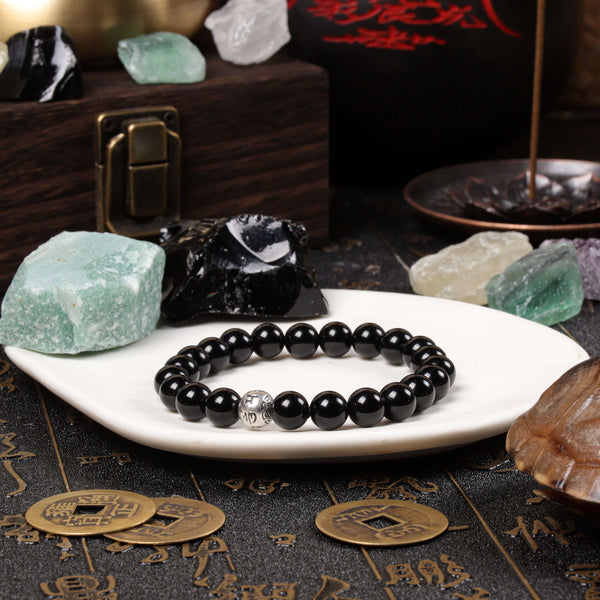
5. Black Tourmaline / Schorl (Trigonal System | Iron-Rich | EMF & Boundary Shield)
Mineral Properties: Trigonal borosilicate $\text{NaFe}_3\text{Al}_6[\text{Si}_6\text{O}_{18}][\text{BO}_3]_3(\text{OH})_4$, rich in iron. Mohs 7–7.5. Possesses measurable pyroelectric and piezoelectric properties.
Feng Shui & Energetic Shielding: Acts as an absorption barrier against outside stress, mental chatter, and modern bedside electronic static (EMF interference from phones and Wi-Fi routers).
Optimal Placement: Place inside your bedroom doorway or beside bedside charging hubs to ground electronic clutter. Limit to one piece per bedroom to avoid suppressing ambient flow.
6. Selenite / Satin Spar (Monoclinic System | Fibrous Gypsum | Water Soluble)
Mineral Properties: Monoclinic hydrous calcium sulfate ($\text{CaSO}_4 \cdot 2\text{H}_2\text{O}$). Mohs 1.5–2. Highly water-soluble.
Feng Shui & Space Purification: Clears stagnant, heavy atmospheric energy and restores a clean, tranquil frequency across the room.
Optimal Placement: Elevate on a high main window sill facing the night sky to cleanse incoming natural energies.
Safety Warning: Keep away from children and pets. Never wash with water; clean only with dry dusting or moonlight.
7. Clear Quartz (Trigonal System | Pure Silicon Dioxide | High Piezoelectricity)
Mineral Properties: Trigonal pure $\text{SiO}_2$ with minimal lattice impurities. Mohs 7. Displays the strongest piezoelectric response in the quartz family.
Feng Shui & Field Amplification: Serves as a master amplifier that reinforces the natural balance of your other bedroom stones.
Optimal Placement: Place in the geometric center or along room corners as an energetic sensor node. Limit to 1–2 small specimens to prevent hyper-activating the room.

Sleep Patterns & Targeted Crystal Pairings
| Sleep Challenge | Primary Symptoms | Recommended Crystals | Strategic Room Placement |
| Racing Mind | Nonstop thoughts, mental loops | Amethyst + Clear Quartz | Amethyst on left nightstand (mind side); small Clear Quartz on right. |
| Anxious Tension | Heavy chest, emotional worry | Lepidolite or Rose Quartz | Heart-level on your primary bedside table. |
| Frequent Nightmares | Light sleep, sudden waking | Smokey Quartz + Tumbled Obsidian | Smokey Quartz under pillow base; smooth Obsidian tumbled stone near doorway. |
| Stagnant Room Chi | Waking up groggy, stuffy room | Selenite | Elevated on main window sill toward natural moonlight. |
| Electronic Clutter | Phone/device next to bed | Black Tourmaline | Positioned directly between charging docks and the bed. |

Where to Place Crystals in Your Bedroom: 5 Strategic Zones
Nightstand (Core Energy Center): Stable temperature zone closest to the resting body. Best for Amethyst (kept 30+ cm from head), Lepidolite, or Rose Quartz.
Under the Pillow/Mattress (Subconscious Grounding): Direct contact point. Best for smooth Smokey Quartz to ground active thought patterns.
Inside the Doorway (Threshold Filter): Highest turbulence and temperature fluctuation. Best for Black Tourmaline to absorb ambient household noise and outside stress.
Main Window Sill (Natural Ambient Filter): Primary portal for moonlight and outdoor airflow. Best for Selenite (kept elevated and away from moisture).
Four Room Corners (Grid Balance): Low-circulation corners prone to energetic settling. Best for small pieces of Clear Quartz (max 2 per room).

Bedroom Crystal Chandeliers & Lamps: Natural Stone vs. K9 Glass
Not every "crystal lamp" delivers genuine mineral resonance. Standard retail fixtures rely on K9 artificial leaded glass—an amorphous material without a crystalline lattice or piezoelectric responsiveness.
Natural Crystal Table Lamps: Raw Amethyst or Selenite base lamps provide genuine crystalline alignment alongside soft ambient lighting. Always pair with 2700K–3000K warm bulbs; cool blue-white lighting (6000K+) suppresses melatonin production and disrupts natural circadian rhythms.
Raw Quartz Chandeliers: Fixtures featuring rough natural Clear Quartz slices help harmonize the ambient field. Avoid aggressively sharp, jagged cut designs, as angular visual tension subtly triggers subconscious stress responses.

What Crystals Should NOT Be in Your Bedroom: The Blacklist
Mineral taboos are grounded in optical physics, neuro-stimulation, and chemical safety:
1. High-Reflectance & Stimulating Warm Minerals (Optical & Mental Triggers)
Citrine ($\text{SiO}_2$ with $\text{Fe}^{3+}$ centers): Radiates vibrant yellow-gold light frequencies that stimulate mental alertness and dopamine production.
Carnelian (Iron-rich Chalcedony): High-saturation orange-red optical wavelengths trigger dynamic vitality and sensory activation.
Tiger's Eye (Pseudomorph Quartz): Chatoyant banded reflections subtly stimulate primal alertness mechanisms.
Sunstone (Aventurescent Feldspar): Metallic hematite plate reflections create sparkling optical movement counterproductive to deep rest.
2. Heavy Metal-Bearing Minerals (Toxicity Concerns)
Malachite ($\text{Cu}_2\text{CO}_3(\text{OH})_2$): High basic copper carbonate content. Contact with sweat or moisture risks copper leaching; toxic if licked by pets or handled carelessly.
Azurite ($\text{Cu}_3(\text{CO}_3)_2(\text{OH})_2$): Brittle copper mineral (Mohs 3.5–4) that easily sheds micro-particulate dust into resting areas.
3. Physical Hazard Minerals
Rough Obsidian: While chemically inert ($\text{SiO}_2$ volcanic glass), raw unworked obsidian exhibits razor-sharp conchoidal fractures. Always use fully tumbled, rounded obsidian stones in sleeping areas.

Crystal Care & Cleansing: Physical Chemistry Guidelines
All maintenance should honor a mineral's physical stability:
Quartz Family (Amethyst, Rose Quartz, Smokey Quartz, Clear Quartz): Highly stable $\text{SiO}_2$ matrix. Cleanse with monthly full moonlight or brief rinses in cool running water (dry immediately). Keep Amethyst out of harsh sunlight.
Black Tourmaline: High chemical stability. Cleanse with dry botanical smudging or moonlight. Avoid strong acids.
Selenite & Lepidolite: Keep strictly dry. Water dissolves gypsum and damages soft mica layers. Dust lightly with a dry soft-bristled makeup brush; re-align via moonlight exposure only.
Obsidian: Highly durable glass structure. Rinse with cool water or smudge; handle carefully to avoid chipping.

The 3-Step Bedroom Crystal Alignment Checklist
Step 1: Verify the Mineral Structure: Match the stone’s atomic lattice to its spatial purpose (Trigonal directional flow for bedside; Monoclinic deep filtering for window thresholds).
Step 2: Check Optical Spectrum: Stick to grounding, calming wavelengths (Violet, Soft Pink, Earth Brown); banish high-alert warm stones (Citrine, Carnelian, Sunstone).
Step 3: Ensure Physical Safety: Restrict total stones to 3–5 items. Keep Selenite dry and elevated, shield Amethyst from direct sunlight, and only use smooth tumbled Obsidian.
A bedroom should not be a battleground of ambient stress and electronic noise. It should be a calibrated, self-sustaining restorative ecosystem. When you understand what a mineral is at the atomic level, you will finally know exactly where it belongs.

Frequently Asked Questions
Q1: Will sleeping with Amethyst under my pillow cause it to fade?
Amethyst fades primarily when exposed to UV sunlight, which breaks down the delicate $[FeO_4]^0$ color centers. While body heat and sweat will not strip its color immediately, placing Amethyst on a shaded nightstand preserves both its optical resonance and physical integrity.
Q2: How do I tell genuine Black Tourmaline apart from Black Obsidian or Leaded Glass?
Black Tourmaline displays distinct trigonal striations and vertical columns with irregular, non-glassy fractures. Obsidian and glass show smooth, glassy shell-like (conchoidal) curved fractures. Tourmaline also exhibits measurable pyroelectric and piezoelectric responses.
Q3: Do crystals need ritual consecration to work in Feng Shui?
From a mineralogical perspective, a stone's crystal system, piezoelectric traits, and optical absorption properties were locked in during geological formation millions of years ago. "Cleansing" serves practically to remove surface oils and dust while resetting static surface charges.
Q4: Do crystals alter biological electromagnetic fields?
Crystal piezoelectricity produces minute, micro-scale electric potential under stress. Their sleep-enhancing benefits function through visual chromotherapy, sensory grounding, intentional ritual, and spatial calibration rather than medical electromagnetic shifts.
Q5: What is the maximum number of crystals I should keep in my bedroom?
Keep your sanctuary calibrated with 3 to 5 well-chosen pieces. Overcrowding conflicting crystal systems can create energetic noise. Start with 1–2 stones and observe your sleep quality for one week before adding more.






Leave a comment