
Does Feng Shui Really Work? The Science, Environmental Psychology, and Cultural Truth Behind Spatial Energy
TABLE OF CONTENTS
- Introduction: That Lingering Feeling When a Space Feels "Off"
- Can You Actually Feel Spatial Energy? Somatics, Neuroscience, and the Architecture of Qi
- The Five Operational Dimensions of Classical Feng Shui
- Does Feng Shui Affect the Human Body or the Environment?
- Can Feng Shui Directly Alter Destiny? Debunking the Instant Wealth Myth
- Who Can Genuinely Assess Spatial Flow? Lineage vs. Modern Credentials
- The True Value of Feng Shui: The 5-Minute Zero-Dollar Audit
- The Modern Renter's Dilemma: Why Wearable Micro-Sanctuaries Matter
- Final Reflections: Environmental Wisdom for Mindful Living
- Frequently Asked Questions (FAQ)
Key Takeaways (The 30-Second Digest)
The Core Reality: Classical Feng Shui is an ancestral, two-thousand-year-old empirical system of neuroarchitecture, circadian ergonomics, and environmental psychology—not supernatural magic or fortune-telling.
The Mechanism: Feng Shui refines your physical habitat; your habitat alters your nervous system; your nervous system guides your decisions, vitality, and actions. It is an indirect environmental catalyst, not an overnight spell.
The Destiny Myth: An aligned layout cannot replace deliberate effort, hard work, or personal accountability. In classical philosophy, spatial placement ranks behind innate potential and cyclical timing, alongside ethical virtue and disciplined learning.
The Zero-Dollar Reset: Over 90% of spatial alignment comes from natural daylight, cross-ventilation, functional furniture ergonomics, and clutter clearing.
The Renter’s Solution: When living in a leased apartment or corporate cubicle where renovations are impossible, intentional talismans—such as HVibeTune wearable energy anchors—serve as tactile micro-sanctuaries to ground your nervous system throughout the day.

Introduction: That Lingering Feeling When a Space Feels "Off"
You sign a lease on a light-filled city apartment, unpack the final box, and settle in. Yet within weeks, an inexplicable heaviness settles in your chest. Your sleep feels fragmented, waking hours are clouded by low-grade brain fog, and creative focus slows down.
Or perhaps your desk at the office gets reassigned to a high-traffic corridor, and your daily productivity instantly plummets.
Inevitably, someone in the holistic wellness community offers the classic advice: "Place a crystal there, hang a mirror, or shift your desk to fix the energy."
Scenarios like these are universally relatable.
Feng Shui—refined across thousands of years of East Asian civilization—remains one of humanity's most enduring frameworks for environmental wellness. Historically recorded as Kanyu (observing the cosmic canopy and earth), Xiangdi (surveying geographical terrain), and Qingnang (the jade pouch canon), it interweaves the Book of Changes, Yin-Yang philosophy, the Five Elements, the Bagua, celestial astronomy, and vernacular architecture.
So, does Feng Shui actually work?
It carries profound cultural heritage and ecological intelligence, but it will not magically fix your life without your active participation. By looking past superstitious claims, we can uncover the distinction between practical environmental optimization and predatory fortune-telling jargon.

Can You Actually Feel Spatial Energy? Somatics, Neuroscience, and the Architecture of Qi
| Environmental Quality | Physiological Signal | Nervous System State | Traditional Description |
| High-Restorative Space | Elevated Frontal Alpha Waves; High Heart Rate Variability (HRV) | Parasympathetic Ease (Rest & Digest) | Vital Qi (Sheng Qi) |
| Chronic Sensory Friction | Sustained Cortisol Spikes; Restricted Breathing Patterns | Sympathetic Arousal (Fight or Flight) | Disruptive Energy (Sha Qi) |
The Classical Definition: Qi, Atmospheric Flow, and the Biophilic Pulse
At the foundation of classical Feng Shui sits a single organizing principle: Qi (Vital Life Force).
In the fourth-century Jin Dynasty classic The Book of Burial (Zang Shu), scholar Guo Pu codified the earliest authoritative definition:
"Qi rides the wind and scatters; it halts at the boundary of water. The ancients gathered it so it would not disperse, guided it so it had a resting place. Hence, it is called Feng Shui (Wind-Water)."
Translated into contemporary science, Guo Pu was describing microclimatic thermodynamics and atmospheric fluid dynamics.
Turbulent drafts and wind corridors strip a space of warmth, moisture, and negative air ions, exhausting the human nervous system. Calm bodies of water and sheltering terrain stabilize ambient temperatures and concentrate vital atmospheric energy. The central objective of Feng Shui is simply storing the wind and gathering the life force—designing an environmental sanctuary that protects human vitality rather than depleting it.
When people remark, "The vibe in this room feels stale," or "This home has incredible energy," they are not channeling the supernatural. They are translating intuitive somatic feedback: draft velocities, electromagnetic fields, humidity variations, visual noise, and circadian light availability.
Spatial Psychology and Neuroarchitecture: Why Spaces Elicit Visceral Reactions
The human brain is a pattern-recognition engine evolved over hundreds of thousands of years in the wild. Neuroarchitecture—the intersection of neuroscience, cognitive psychology, and architectural design—demonstrates that interior geometry continuously primes human physiology:
Restorative Geometries vs. Visual Noise: Open, sunlit rooms with biophilic vistas, natural materials, and uninhibited sightlines stimulate the parasympathetic nervous system, inducing states of restorative ease. Ancestral texts classify this as vibrant Sheng Qi (generative vitality).
Sensory Friction and Spatial Threat: Narrow hallways with blind spots, sharp interior pillars protruding toward seating areas, exposed structural beams overhead, and cluttered pathways keep the amygdala in low-grade vigilance. Classical texts label these architectural stressors Sha Qi (disruptive, stagnant, or aggressive energy).
What our ancestors documented through symbolic metaphysics, modern cognitive science recognizes as the nervous system's environmental adaptation response.
What Modern Empirical Research Reveals: Brainwaves, HRV, and Cortisol
Scientific interest in traditional spatial principles has moved from theoretical discourse into laboratory experimentation:
Neuroelectric and Endocrine Responses: Controlled experiments utilizing virtual reality environmental modeling have shown that rooms arranged according to sheltering perimeter principles induce statistically significant increases in frontal lobe alpha wave amplitudes (associated with calm, focused awareness) alongside measurable decreases in salivary cortisol secretions. These findings align with established Attention Restoration Theory.
Autonomic Nervous System Adaptations: Biometric evaluations investigating spatial orientation protocols documented in classical literature show that balanced interior arrangements elevate Heart Rate Variability (HRV)—the clinical benchmark for autonomic adaptability and stress resilience—while producing positive shifts in standardized mood profiles.
Circadian and Traditional Parallels: Traditional Eastern medicine operates on the physiological unity of the individual and the cosmos. When an individual's immediate habitat conflicts with natural diurnal rhythms, internal physiological homeostasis fractures.
These empirical investigations do not prove that invisible spirits navigate your hallways. Rather, they provide scientific validation that spatial geometry, orientation, and lighting dynamically regulate endocrine balance and neurological performance.
Somatic Feedback vs. Supernatural Mystery
Your visceral comfort inside a well-designed room is real, but its origin is biological: balanced circadian light, acoustic absorption, clean air exchange, and ergonomic circulation.
Appreciating ancestral wisdom does not require surrendering to superstition. By grounding historical observations in cognitive science, we preserve the authentic depth of the tradition while freeing ourselves from unnecessary anxiety.

The Five Operational Dimensions of Classical Feng Shui
1. The Cultural-Symbolic Dimension: Archetypes, Rituals, and Sacred Geometry
Traditional Feng Shui relies on a rich visual lexicon: the Bagua energy map, protective gourds, celestial animal guardians, Five-Emperor coins, and celestial compasses.
Its structural rituals—sacred consecration ceremonies, spatial clearings, and seasonal groundbreakings—parallel protective rules against intersecting roadway rushes, heavy overhead structural beams, and mirrors directly facing the foot of the bed.
These components function as archetypal cultural tools that externalize human hopes for security, longevity, and equilibrium. While bronze coins will not alter the trajectory of financial markets, these sacred artifacts remain respected cultural expressions of mindfulness and ancestral heritage.
2. The Spatial-Sensory Dimension: Biophilia, Ergonomics, and Traffic Flow
Human perception of space is multifaceted. Our instinctual impression of whether a room feels expansive or draining ties directly to evolutionary survival instincts: natural light, safe resting perimeters, and clear paths of movement.
The ancient Form School evaluated mountain contours, winding water veins, and building profiles. Stripped of poetic metaphor, it was a rigorous, hands-on survey of landscape ergonomics, sightlines, and defensive environmental orientation.
3. The Psychological Dimension: Environmental Anchors and Perceived Agency
An intentional sanctuary relieves chronic stress, reinforces personal safety, and elevates baseline emotional regulation. Arranging a room with care creates a tangible psychological anchor, generating a healthy sense of autonomy over your immediate reality.
Talismanic objects, energized crystals, and personalized bracelets serve as physical manifestations of mindfulness, providing daily positive affirmations.
The late Professor Lou Yulie, one of China’s most revered scholars of Eastern philosophy and Senior Professor at Peking University, captured this dynamic with remarkable clarity:
"Feng Shui talismans and auspicious emblems function fundamentally as mechanisms of psychological suggestion. When you genuinely believe an object brings harmony, it provides mental resilience and inner encouragement. It is an external reinforcement—yet the actual work must still be accomplished through your own effort; the object cannot live your life for you. For someone struggling with self-doubt, such external supports can offer meaningful comfort; for someone possessing deep internal resilience, their practical utility is negligible."
4. The Behavioral Priming Dimension: Habit Loops and Cognitive Load
Organized, intentional environments foster executive function and mental clarity; chaotic, suffocating settings amplify procrastination and irritability.
Environmental triggers steadily shape habitual behaviors:
Positioning your desk in the classical Command Position (facing the doorway with a solid wall behind you) eliminates subconscious hyper-vigilance, freeing cognitive energy for deep work.
Keeping entryways clear of clutter prevents decision fatigue from setting in the moment you step through your front door.
Eliminating visual clutter on nightstands directly reduces pre-sleep sensory processing, encouraging natural melatonin release.
5. The Sociocultural Dimension: Ancestral Heritage and Collective Belonging
On a broader scale, Feng Shui serves as a shared cultural blueprint. The architectural orientations of traditional courtyard residences, ancestral clan temples, and historic river hamlets structurally unified communities around familial reverence, communal safety, and ecological coexistence.
Cultural meaning should never be mistaken for direct physical causation, but its capacity to build community identity remains undeniably powerful.

Does Feng Shui Affect the Human Body or the Environment?
Classical Philosophy: The Macrocosm-Microcosm Harmony
Ancient philosophy viewed heaven, earth, and humanity as an interdependent continuum:
Yin and Yang Dynamics: Mountains embody stillness, stability, and restoration (Yin); moving waterways embody kinetic movement, light, and trade (Yang).
The Living Landscape: Nestling structures with their back to northern winter hills while facing southern daylight waters—embracing the light while leaning into stillness—constitutes the archetypal living landscape.
The Five Elements: Wood, Fire, Earth, Metal, and Water map systemic interactions across seasonal changes, architectural materials, and color temperatures.
The Bagua: Eight foundational trigrams categorize spatial compass sectors, family archetypes, and temporal phases, serving as the analytical engine of the Compass School.
The central goal of these practices is not to alter the individual directly, but to harmonize their surrounding habitat with broader seasonal, planetary, and topographical rhythms.
The Physical Environment as the Primary Medium
Feng Shui works on the room, the home, the furniture alignment, the airflow paths, and the natural lighting angles. Its primary canvas is always your physical space.
It does not target the human body like acupuncture or medicine; instead, it shapes the surrounding container within which the body lives, breathes, and rests.
The Indirect Cascade: Environment to Nervous System to Human Performance
The Physical Mechanism: Ambient geomagnetism, particulate air counts, ambient temperature, humidity balance, and natural circadian light cycles regulate hormonal balance and sleep architecture.
The Physiological Mechanism: Modern medical studies show that bed orientations aligned with natural magnetic lines can influence resting pulse, baseline blood pressure, and sleep cycle continuity. Similarly, desk positions featuring uninhibited natural daylight significantly boost alertness, visual comfort, and task completion speed.
The Ergonomic Mechanism: Removing daily spatial friction directly calms nervous tension.
Professor Lou Yulie illustrated this through an everyday example:
"In domestic Feng Shui, when an individual writes with their right hand, placing the desk so natural light falls from the left side avoids cast shadows. Positioning the desk to avoid having your back directly to an unlatched door keeps you from startling whenever someone quietly enters.
Residing in a home with supportive Feng Shui leaves a person energized and clear-headed, which naturally pours into productive work; living in a windowless room deprived of sunlight wears down health, clouds morale, and ultimately stifles vocational focus."
The Core Mechanism: An Indirect Environmental Catalyst
Feng Shui refines your surroundings; your surroundings influence your mind and body.
It operates as an indirect environmental catalyst, not an immediate magical spell. It transforms where you dwell, and that transformed habitat supports your vitality.

Can Feng Shui Directly Alter Destiny? Debunking the Instant Wealth Myth
Ancient Priorities: First Destiny, Second Luck, Third Feng Shui
The classic Chinese saying—"First is Destiny, Second is Luck, Third is Feng Shui, Fourth is Accumulating Virtue, and Fifth is Education"—comes from the Qing Dynasty novel The Tale of Heroic Sons and Daughters.
Notice that Feng Shui appears third on this list:
Destiny: Inherent constitution, background, and innate gifts.
Luck: Natural macroeconomic timing, seasons, and life stages.
Feng Shui: Environmental alignment and spatial efficiency (a secondary catalyst).
Virtue: Ethics, integrity, empathy, and social goodwill.
Education: Continuous learning, discipline, and daily execution.
Our ancestors never viewed spatial placement as the sole arbiter of life. It was immediately followed by personal character, ethical integrity, persistent study, and disciplined daily habits.
The Hard Truth: Spaces Cannot Replace Effort
Feng Shui cannot land a corporate promotion for you, balance your investment portfolio, create unearned wealth, or insulate you from life's natural ups and downs.
Touting Feng Shui as an instant shortcut to financial windfalls is an exaggeration, often used to sell false promises.
Professor Lou Yulie offered an unvarnished critique of commercialized superstition:
"Selecting a home through the lens of Feng Shui is designed to foster a healthy, comfortable, uplifting environment that supports personal vitality and peace of mind. Shifting your spatial arrangement can refresh your outlook—it cannot directly make you an official or multiply your fortune.
The assertions made by certain practitioners that structural tweaks guarantee instant promotions, sudden wealth, or generational fortunes rely on strained associations and superstitions, frequently deployed to extract cash.
A person's foundational traits may be static, but their circumstances move and evolve constantly. It is entirely acceptable to utilize external supports, but the ultimate duty is to master what is directly within your control today, moving forward step by methodical step."
An Environmental Catalyst, Not a Proxy for Action
A supportive room clears away mental fog and calms nervous tension, helping you sleep soundly, think clearly, and feel centered. However, it cannot make difficult decisions, take creative risks, or put in the work for you.
The agency to shape your life always remains in your own hands.
How to Spot Exploitative Charlatans: Red Flags to Avoid
| Practitioner Profile | Operational Methods | Primary Focus | Red Flags |
| Trustworthy Spatial Guide | Rooted in environmental psychology, ergonomics, and classical balance. | Actionable improvements in lighting, airflow, sightlines, and circulation. | None; offers transparent advice, encourages autonomy, and uses zero fear tactics. |
| Predatory Charlatan | Relies on superstitious threats, manufactured urgency, and mystical jargon. | Selling expensive talismans, exclusive curses/cures, and secret rituals. | "You will face catastrophe this month unless you buy this cure." Promises overnight wealth. |

Who Can Genuinely Assess Spatial Flow? Lineage vs. Modern Credentials
Classical Lineages: Form School vs. Compass School
Historically, genuine expertise was passed through dedicated master-apprentice lineages, regional traditions, and classical commentaries. Two primary streams emerged:
The Form School (Xingshi): Established during the Han Dynasty and systematized during the Tang Dynasty by master Yang Yunsong, this branch focused on tangible topographical landscapes. It analyzed geographic vitality through five physical anchors: mountain veins, energy nodes, sheltering hills, watercourses, and facing orientations. Its methods are grounded, visible, and deeply practical.
The Compass School (Liqi): Solidified during the Song Dynasty under scholars like Lai Wenjun, this tradition emphasized subtle cosmological time-space alignments. It evaluated habitats mathematically using the celestial Luopan compass, seasonal stems, and shifting temporal cycles.
While classical masters studied both approaches, true masters of both disciplines were historically rare.
The Modern Credential Industry: Commercial Guilds vs. Real Knowledge
In the modern era, "Feng Shui Master" is not an officially regulated civil profession under national occupational licensing registries—neither within East Asian regulatory frameworks nor across Western professional licensing bodies.
Most "Certified Feng Shui Master" diplomas circulating on the internet originate from private hobbyist associations or pay-to-print commercial registries. Investigative reports routinely show that many of these certificates require no rigorous examinations or apprenticeships—simply paying an administrative processing fee is often enough to have a decorative document mailed out.
True competence does not rest on an unverified paper certificate. It rests on a deep understanding of environmental design, human biology, and an ethical commitment to avoid fear-mongering.

The True Value of Feng Shui: The 5-Minute Zero-Dollar Audit
Cultural Preservation: Vernacular Architectural Ecology
Feng Shui preserves thousands of years of architectural observation, tracking how wind currents, light angles, humidity, and building layouts interact with human well-being. Historic monuments like Beijing's Forbidden City, traditional courtyard villages, and classical gardens all reflect this balance with nature.
Even setting spiritual beliefs aside, it remains an extraordinary architectural legacy worth appreciating.
Practical Equation: Optimization Over Magic
Effective spatial alignment can be expressed through a simple formula:
Effective Feng Shui = Circadian Daylight + Fresh Airflow + Ergonomic Layout + Visual Order + Somatic Safety
At its foundation, genuine spatial harmony is a blend of environmental psychology, interior ergonomics, and mindful, comforting design.
Actionable Toolkit: The 5-Minute Zero-Dollar Spatial Reset
Clear the Threshold (1 Minute): Remove shoes, shipping parcels, and loose bags from your front entrance. Cluttered entryways create immediate visual friction the moment you arrive home.
Assume the Command Position (2 Minutes): Angle your primary workspace so your back is protected by a solid wall and you have a clear diagonal view of the doorway. If your desk must face a wall, place a small desktop mirror nearby to keep the room in view.
Reset Circadian Lighting (1 Minute): Turn off harsh, cool overhead fluorescent lighting after sundown. Shift to warm floor lamps (2700K) positioned below eye level to support natural melatonin production.
Flush Stale Air (1 Minute): Open two opposing windows for five minutes every morning to exchange indoor carbon dioxide for fresh oxygen, restoring indoor air quality regardless of outside temperatures.
The most transformative spatial adjustments rarely cost a thing.

The Modern Renter's Dilemma: Why Wearable Micro-Sanctuaries Matter
The Architectural Constraint: You Cannot Knock Down Your Landlord's Walls
For millions of urban professionals, renting an apartment or working from a leased cubicle brings real design limitations.
You cannot tear down a drywall partition to invite southern morning light into a windowless bedroom. You cannot relocate your kitchen's plumbing lines, knock down an awkwardly placed beam, or shift the apartment's front door to improve circulation. If you work from home in a studio apartment, your desk often sits right beside your bed out of necessity.
When the surrounding architecture cannot be changed, how can you maintain a sense of calm and energetic boundaries?
This real-world limitation is why our ancestors developed wearable micro-sanctuaries.
| Spatial Approach | Scale | Direct Medium | Primary Benefit |
| Architectural Feng Shui | Macro-Environment | Walls, windows, daylight, and physical layout. | Creates a restorative, low-friction living container. |
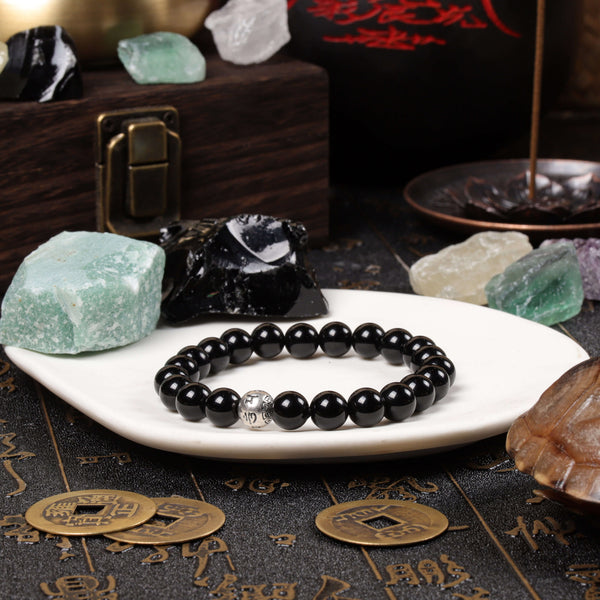
| HVibeTune Wearable Anchors | Micro-Environment | Natural stones, tactile materials, and personal intent. | Regulates the nervous system through touch and mindfulness. |
HVibeTune Bracelets: Portable Micro-Energy Anchors for Daily Grounding
When you cannot reshape your building's floor plan, you can still shape your immediate personal space.
Drawing on centuries of artisanal heritage and Eastern metaphysical balance, HVibeTune Feng Shui Bracelets are designed to meet this exact modern need. They distill foundational principles—Five-Element balance, lunar zodiac archetypes, the Bagua, protective guardians, and carved natural stones—into an elegant, wearable daily anchor.
Wearing a mindful piece will not move physical walls or alter a building's foundations. What it does provide is a portable personal anchor—a tangible connection to timeless principles of harmony that stays with you throughout the day.
Somatic Grounding: How Tactile Stones Regulate the Nervous System
In somatic psychology, touch plays a key role in calming the nervous system. When work stress or city noise threatens your equilibrium, holding a physical grounding anchor—like cool natural obsidian, smooth red agate, or carved sandalwood—activates deep sensory pathways that help soothe an overstimulated mind.
Rather than viewing a bracelet as an external good-luck charm, think of it as a wearable sensory anchor.
Each time your fingers brush the natural beads throughout a hectic workday, it offers a gentle sensory pause: an invitation to release jaw tension, take a deep breath, and return to center.
Consecration and Intention: The Value of Sacred Ritual
In Eastern culture, consecration represents a dedicated ceremony where an artisan or practitioner cleanses an object and seals it with focused, mindful intention.
Modern science does not measure metaphysical blessings on a meter, yet the human value of sacred intention remains profound. Approached with self-awareness, a consecrated piece acts as a meaningful touchpoint—a physical reminder of your personal values, your emotional boundaries, and your commitment to caring for your inner space.
That deliberate clarity carries a grounding strength all its own.
Harmonizing with Professor Lou's Principle: An Outward Ally, An Inward Truth
This grounded approach aligns seamlessly with Professor Lou Yulie's perspective on auspicious jewelry:
"Such an item serves as a mindful prompt—its influence lives in how you relate to it. It offers outward encouragement, while the real steps in life remain yours to take.
For someone seeking an extra boost of confidence, that external reminder can offer genuine reassurance; for someone already deeply anchored in their own resolve, it simply rests as a pleasing accessory."
If you wear an HVibeTune bracelet with mindful intention, it serves as a steadying, personal touchstone. If you wear it simply for its aesthetic craftsmanship, it stands as an elegant celebration of traditional art. Its ultimate value lives not in the mineral beads themselves, but in the mindfulness and clarity you cultivate while wearing them.

Final Reflections: Environmental Wisdom for Mindful Living
| What Truly Works in Spatial Practice | What Does Not Work (Superstition & Hype) |
| Neuroarchitecture and ergonomic room design | Overnight wealth rituals and lottery charms |
| Circadian daylight and natural cross-ventilation | Fatalistic beliefs that a layout controls your destiny |
| Decluttering high-traffic areas to reduce cognitive load | High-priced cures sold through manufactured fear |
| Tactile grounding anchors for nervous system regulation | Passive waiting without daily disciplined effort |
Feng Shui brings together ancient philosophy, artistic heritage, and common-sense environmental design:
Where it shines: In refining physical habitats. Intentional space design measurably supports our nervous systems, mental clarity, and daily routines—truths now reinforced by emerging biometric and environmental research.
Where it falls short: In promising effortless life makeovers. No credible evidence suggests that moving a plant or hanging a mirror will instantly bring wealth, fame, or an easy road forward.
Its real gift lies in a simple, supportive loop: improve your space to steady your mind, and let that calm mind guide better actions.
Take inspiration from its rich history, lean into its practical environmental wisdom, and leave fear-based superstitions behind.
The most supportive spaces are built on simple essentials: natural daylight, fresh circulating air, thoughtful organization, clean surfaces, and a genuine commitment to showing up for your life each day.
A peaceful home supports you, but it cannot walk the path for you. The space sets the stage; the journey is yours to live.

Frequently Asked Questions (FAQ)
Q1: Is Feng Shui a real science, a philosophy, or pure superstition?
Classical Feng Shui sits at the intersection of vernacular architecture, human ergonomics, and traditional natural philosophy. Its core guidelines address observable factors: sunlight angles, ventilation, acoustic comfort, and spatial circulation. The superstitious elements—like guarantees of sudden wealth or threats of family misfortune—are later commercial distortions. Approached with common sense, it serves as an insightful, ancestral system of environmental psychology.
Q2: What is the direct connection between the Book of Changes and Feng Shui?
The Book of Changes (I Ching) forms the theoretical backbone of classical Feng Shui. The balance of Yin and Yang, the cyclical interactions of the Five Elements, and the spatial orientations of the Bagua all trace back to this foundational work. Understanding the Compass School is nearly impossible without appreciating this classic cosmological framework.
Q3: Can adjusting my bedroom's Feng Shui instantly attract wealth or career success?
No. Moving a bed or hanging a mirror will not magically alter financial markets or land a promotion for you. What thoughtful bedroom design does do is optimize sleep quality, calm nighttime cortisol levels, and eliminate visual clutter. Waking up rested and clear-headed puts you in a much better position to make good decisions, stay focused, and seize professional opportunities.
Q4: Do Feng Shui bracelets actually work, or are they merely decorative?
They work as mindful, sensory grounding anchors. While slipping on a bracelet will not rewrite your financial reality, touching smooth, natural stones offers a tangible moment of calm during stressful days. In modern somatic psychology, this physical touchstone helps settle nervous system tension, keeping you centered in challenging environments.
Q5: Does a consecrated talisman hold real spiritual power?
Consecration ceremonies carry deep cultural meaning, yet their true power lives in psychological intention. As Professor Lou Yulie observed, such rituals offer an external source of encouragement. Approached with self-awareness, a consecrated piece serves as a clear physical reminder of your personal boundaries and focus. Expecting it to magically solve life's challenges without personal effort misses the point entirely.
Q6: How can I tell if a Feng Shui practitioner is trustworthy?
Be cautious of any consultant who relies on fear tactics (e.g., claiming disaster is imminent without an expensive cure) or promises effortless riches and fame. An authentic consultant focuses on clear, practical improvements: maximizing natural daylight, improving room ventilation, decluttering high-traffic areas, and setting up comfortable, ergonomic furniture layouts—all with transparent pricing.
Q7: How can renters apply Feng Shui when they cannot remodel or repaint?
Focus on non-structural adjustments: keep entryways clean and welcoming, angle your desk into the Command Position, switch to warm evening lamps (2700K) instead of harsh overhead bulbs, and open windows daily for fresh air. To personalize an environment you cannot structurally alter, incorporating portable items—like lush house plants, natural crystals, or a wearable HVibeTune piece—creates a portable sense of calm and intentional design.
Q8: Does believing in Qi contradict modern scientific thinking?
Not at all, provided Qi is understood through its classical definition. Rather than a mystical force, classical texts describe Qi as dynamic life-affirming conditions: clean airflow, natural daylight, comfortable humidity, and biophilic balance. Modern neuroarchitecture and environmental medicine evaluate these identical factors to measure autonomic resilience and mental well-being.
Q9: Is an HVibeTune Feng Shui bracelet worth purchasing?
If you appreciate traditional craftsmanship, draw inspiration from Five-Element symbolism, and want an everyday sensory anchor to help you stay grounded, it is a thoughtful and stylish choice. Approach it as an intentional, mindfulness-based companion rather than a supernatural fix. Its real value begins with the calm mindset you bring to it every day.
Q10: What is the single most essential rule of a balanced home?
The most vital principle is nervous system safety and somatic comfort. It has little to do with expensive trinkets or complicated formulas; it centers on whether your space allows you to breathe easily, focus without distraction, and rest deeply. When your environment supports your peace of mind, your energy rebounds naturally—and that inner clarity is what helps everything else in life flow more smoothly.






Leave a comment