
The Complete Bagua Guide: Origins, Trigram Meanings, and Modern Life Application
TABLE OF CONTENTS
- What Is Bagua? (And What Is a Trigram?)
- The Origins of the Bagua: Who Created the Eight Trigrams?
- What Did the Eight Trigrams Represent? Symbolism, Directions, and Elements
- The Deeper Spiritual Meaning of Bagua: Ancient Wisdom for Modern Mindfulness
- How Bagua Manifests Across Different Traditions: One Root, Diverse Branches
- Bringing Balanced Energy into Daily Life: The Feng Shui Bagua Bracelet
- Frequently Asked Questions About the Eight Trigrams
Have you ever noticed the iconic circular emblem featuring the swirling Yin-Yang symbol framed by eight distinct sets of three stacked lines?
This ancient emblem is the Bagua (pronounced bah-gwah)—literally translating to the Eight Trigrams.
Far from being mere folklore, the Eight Trigrams represent one of humanity’s oldest philosophical systems for understanding nature, the universe, and the subtle flow of vital life energy (Qi). Whether you are exploring Eastern metaphysics, preparing to harmonize your living space, or seeking daily mindfulness, understanding the Bagua gives you a timeless framework to navigate life’s constant changes.

What Is Bagua? (And What Is a Trigram?)
To understand the system, we must begin with its foundational unit: what is a trigram?
Quick Definition: A trigram (known in traditional philosophy as a Gua) is an ancient three-line archetype symbolizing one of the eight fundamental forces of nature. Together, these eight cosmic archetypes form the Bagua—the core philosophical and diagnostic framework of the I Ching (Book of Changes).
Centuries ago, ancient Eastern sages observed that all dynamic forces in the physical and spiritual world could be distilled into eight primary elemental expressions:
Heaven and Earth (The celestial creative force and the receptive physical ground)
Thunder and Wind (The dynamic spark of initiation and the gentle dispersion of energy)
Water and Fire (The deep, fluid current of mystery and the radiant light of clarity)
Mountain and Lake (The grounded boundary of stillness and the joyful reservoir of calm)
To record these forces without the limitations of spoken words, they designed eight geometric figures using two primal building blocks:
A Solid Line (—): Called a Yang line. It embodies active light, motion, strength, firmness, and the expansive energy of Heaven.
A Broken Line (- -): Called a Yin line. It represents receptive darkness, stillness, softness, intuitive contemplation, and the grounding presence of the Earth.
By stacking three Yin or Yang lines in every possible mathematical permutation (two to the third power equals eight), the Eight Trigrams were revealed.
The Eight Sacred Trigrams: Symbols and Core Energies
Here is the essential reference chart explaining each sacred symbol, its transliterated name, natural force, elemental resonance, and archetypal energy:
| Trigram Symbol | Trigram Name | Natural Force | Elemental Quality | Core Archetype & Energy |
| ☰ | Qian | Heaven | Yang Metal | Strength, creative initiative, noble leadership |
| ☱ | Dui | Lake / Marsh | Yin Metal | Joy, open communication, heartfelt celebration |
| ☲ | Li | Fire | Fire | Radiant awareness, clarity, beauty, visibility |
| ☳ | Zhen | Thunder | Yang Wood | Awakening impulse, courage, expansion, breakthrough |
| ☴ | Xun | Wind | Yin Wood | Gentle flexibility, persistence, gradual growth |
| ☵ | Kan | Water | Water | Deep wisdom, adaptability, life journey, resilience |
| ☶ | Gen | Mountain | Yang Earth | Stillness, grounding meditation, healthy boundaries |
| ☷ | Kun | Earth | Yin Earth | Total receptivity, maternal nourishment, unconditional support |
From the Eight Trigrams to the 64 Hexagrams of the I Ching
The Eight Trigrams are the foundational alphabet of Eastern cosmology. When paired on top of one another (eight multiplied by eight), they form the 64 Hexagrams (six-line figures) that constitute the diagnostic text of the I Ching.
If the Eight Trigrams are the primary notes of universal energy, the 64 hexagrams depict the living symphony of human experiences, decisions, and transformations.

The Origins of the Bagua: Who Created the Eight Trigrams?
When exploring who created the eight trigram tradition, history and legend point to Fu Xi, one of the foundational cultural figures of ancient Eastern heritage.
According to ancient lore, Fu Xi stood between Heaven and Earth, contemplating the celestial movements across the stars, studying the natural shifts across mountains and waterways, and observing the patterns of birds and wildlife. Seeking an intuitive language to record how the cosmos operates, he drew the first two lines—the unbroken Yang and the broken Yin.
This pivotal breakthrough has been revered for generations as the moment a single stroke opened human consciousness to understand the universe.
The Five Stages of Cosmic Unfolding
In traditional Taoist cosmology, creation unfolds in an organic sequence:
Wuji (The Boundless Void): The primordial stillness of pure potential before form or creation began.
Taiji (The Unified Whole): The awakening of a unified whole—the initial spark of manifestation.
Yin and Yang (Dual Polarities): The emergence of dual, complementary forces—light and dark, active and receptive.
The Four Symbols (Si Xiang): The cyclical progression into four distinct states—dawn, midday, dusk, and night; or the four natural seasons.
The Eight Trigrams (Bagua): The full articulation of nature’s eight elemental archetypes.
Early Heaven vs. Later Heaven Bagua: Sacred Order vs. Real-World Application
Throughout centuries of lineage practice, master practitioners defined two primary arrangements of the Eight Trigrams:
The Early Heaven Bagua (Xian Tian): Attributed to Fu Xi, this sequence places Qian (Heaven) directly at the top and Kun (Earth) at the bottom, pairing opposing natural forces in perfect balance (Fire opposite Water, Mountain opposite Lake). It depicts the ideal, untouched order of the cosmos—a meditative blueprint of spiritual stillness.
The Later Heaven Bagua (Hou Tian): Attributed centuries later to King Wen of Zhou, this sequence arranges the trigrams according to how energy flows through the physical world, aligning with the seasons and compass directions (with Fire in the South and Water in the North). This is the dynamic, practical arrangement used in Classical Feng Shui, space alignment, and personal well-being.
Key Takeaway: Early Heaven represents universal, timeless principles; Later Heaven represents real-world physical and energetic applications.

What Did the Eight Trigrams Represent? Symbolism, Directions, and Elements
In Classical Feng Shui, each trigram corresponds to a specific compass direction, an element from the Five Elements system, and a human archetype within a household:
| Trigram | Natural Force | Compass Direction | Five Elements | Family Archetype | Associated Life Attribute |
| Qian | Heaven | Northwest | Metal | Father / Elder Leader | Strength, authority, mentor connection |
| Kun | Earth | Southwest | Earth | Mother / Matriarch | Grounding, nourishment, partnership |
| Zhen | Thunder | East | Wood | Eldest Son | Health, ancestry, dynamic initiative |
| Xun | Wind | Southeast | Wood | Eldest Daughter | Prosperity, gentle momentum, growth |
| Kan | Water | North | Water | Middle Son | Career flow, deep wisdom, resilience |
| Li | Fire | South | Fire | Middle Daughter | Recognition, fame, spiritual brilliance |
| Gen | Mountain | Northeast | Earth | Youngest Son | Inner stillness, meditation, boundaries |
| Dui | Lake | West | Metal | Youngest Daughter | Joy, artistic creativity, fulfillment |
The Four Primary Pillars to Anchor First
To begin working with the Bagua, anchor these four cardinal energies in your daily awareness:
Qian (Heaven / Northwest): Directing purposeful leadership and inviting wise mentors into your circle.
Kun (Earth / Southwest): Cultivating supportive relationships, patience, and unconditional stability.
Li (Fire / South): Elevating clarity, honest self-expression, and public recognition.
Kan (Water / North): Navigating career transitions with fluid adaptability, wisdom, and grit.

The Deeper Spiritual Meaning of Bagua: Ancient Wisdom for Modern Mindfulness
Beyond technical charts, the Bagua offers three profound spiritual principles for intentional, modern living:
1. Seeing Life as an Interconnected Whole
The Bagua teaches that humans are not isolated observers of nature; we are woven directly into it. The rhythms of the heavens and earth mirror the rhythms of our emotions, physical wellness, and home environment. When your daily life honors natural balance, personal harmony follows.
2. Embracing Constant Change as the Natural Rhythm
The concept of change is central to Eastern wisdom. Nothing in life remains fixed. Just as winter yields to spring, challenging seasons in your career or relationships naturally shift toward renewal. The Eight Trigrams teach us not to fear change, but to harmonize with it.
3. Seeking Dynamic Balance Over Rigid Control
Yin and Yang are not rigid polarities of good versus bad. Excessive stillness leads to stagnation; relentless activity leads to exhaustion. The Bagua encourages living in alignment with natural momentum—pausing when weary and moving decisively when inspired.

How Bagua Manifests Across Different Traditions: One Root, Diverse Branches
A common question newcomers ask is why the word "Bagua" appears in so many diverse fields—from residential layouts to martial arts, military strategy, and spiritual jewelry.
Think of Bagua as a singular, ancient seed. Over centuries of continuous practice, that seed grew into distinct, practical branches:
1. The Sacred Bagua Symbol
The circular Bagua symbol features the central Taiji (Yin-Yang) encircled by the eight protective trigrams. Historically placed over thresholds or worn as protective amulets, this sacred geometric configuration helps disperse chaotic ambient energy and anchor centered harmony in any space. Today, it remains an enduring symbol of spiritual balance and mindful living.
2. The Feng Shui Bagua Map (Nine Palaces Grid)
In modern interior alignment, the Later Heaven Bagua is expressed as the Feng Shui Bagua Map, also known as the Nine Palaces grid.
This system superimposes nine energetic sectors over your living space, correlating specific physical areas of your home with core life aspirations:
| Southeast (Xun)Wealth & Abundance | South (Li)Fame & Illumination | Southwest (Kun)Love & Relationships |
|
East (Zhen) Health & Family Roots |
Center (Taiji) Overall Balance & Vitality |
West (Dui) Children & Joyful Creativity |
|
Northeast (Gen) Knowledge & Meditation |
North (Kan) Career Path & Life Flow |
Northwest (Qian) Helpful Mentors & Travel |
Deepen Your Space Practice:
Looking to apply this grid to your apartment, bedroom, or workspace floor plan? Explore our step-by-step practical companion guide: How to Use the Feng Shui Bagua Map in Your Home (Room-by-Room Guide).
3. The Nine Palace Bagua Formation
In classical military history, master strategists developed the renowned Nine Palace Bagua Formation. Operating on the eight directional gates and continuous Yin-Yang variations, this strategic formation redirected opposing momentum through circular, balanced movement. This spatial geometry went on to inspire imperial courtyard architecture, garden labyrinths, and classical literature.
4. Bagua Zhang: Internal Martial Arts and the Pop Culture Legacy
When the Eight Trigrams are channeled through physical movement, they become Bagua Zhang (Eight Trigrams Palm), one of the three prominent internal martial arts alongside Tai Chi and Xingyi Quan.
Practitioners utilize continuous circle-walking, spiraling body mechanics, and palm strikes oriented along the eight compass directions, cultivating soft external mobility backed by firm internal rooting.
The Pop Culture Connection: Fans of Japanese manga and anime frequently recognize these principles from Naruto. The Hyuga clan’s signature techniques—most notably Neji’s Eight Trigrams Sixty-Four Palms and the Eight Trigrams Palm Revolving Heaven—drew direct creative inspiration from authentic Bagua Zhang circular footwork and the sixty-four combinations of the I Ching.
5. Wearable Energy & Protection
Throughout history, the harmonizing principles of the Bagua were translated into personal, wearable objects designed to accompany individuals on their journeys:
The Bagua Coin: Traditional metal coins cast with the eight trigrams, traditionally used to stabilize prosperity and personal vitality.
Jade Bagua Pendants: Carved from natural jade, combining the cooling, protective quality of natural stone with sacred geometry.
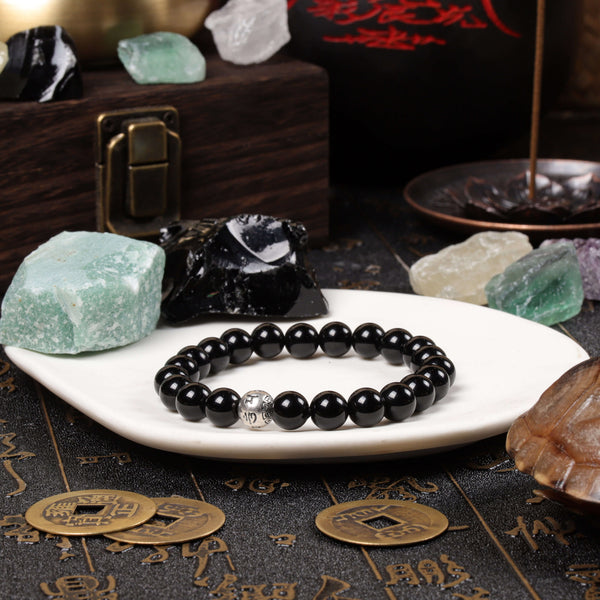
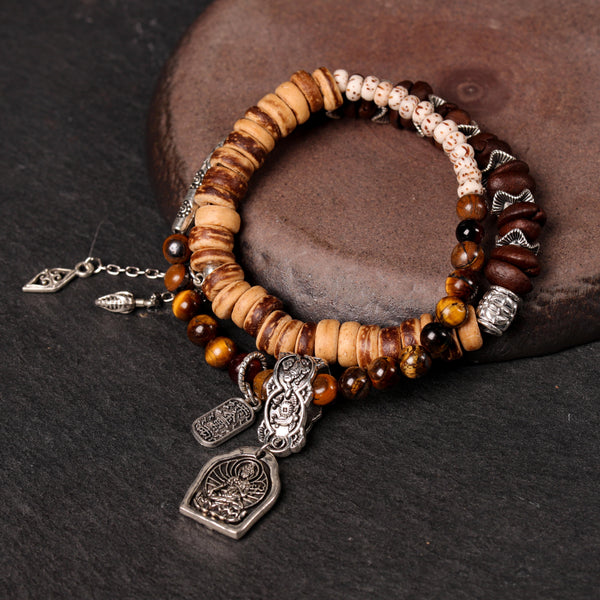
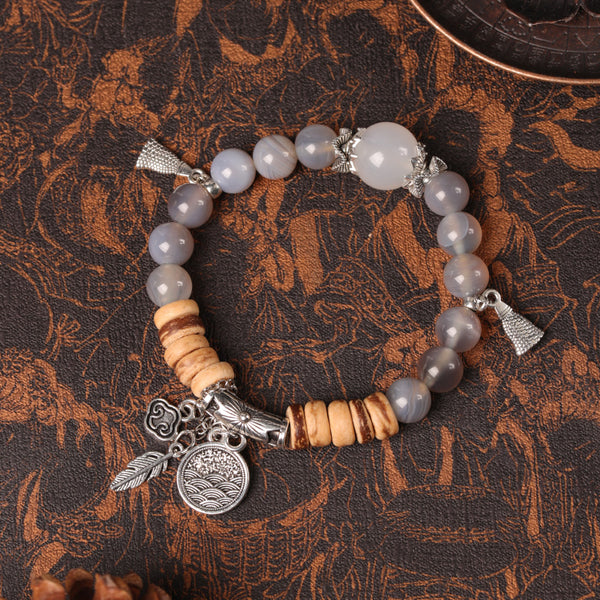
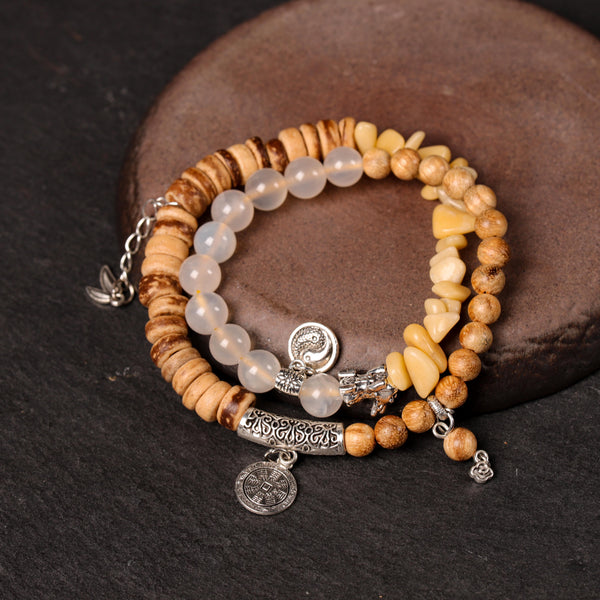
The Feng Shui Bagua Bracelet: A refined, modern expression combining natural gemstones with the Eight Trigrams to anchor daily balance.

Bringing Balanced Energy into Daily Life: The Feng Shui Bagua Bracelet
While studying the philosophy of the Eight Trigrams deepens intellectual understanding, embodying its balanced harmony throughout demanding modern schedules is where practical transformation begins.
A thoughtfully crafted Feng Shui Bagua bracelet serves as an intentional daily anchor. By uniting the sacred geometry of the Eight Trigrams with the grounded natural resonance of authentic gemstones—such as protective Black Obsidian, stabilizing Tiger’s Eye, or clear Amethyst—it provides a tactile reminder to stay centered in your personal power.
Whether worn during morning meditation, kept on your wrist as an energetic boundary in high-stress environments, or shared as a meaningful gift, it serves as a personal touchstone for dynamic equilibrium, clarity, and mindful presence.

Frequently Asked Questions About the Eight Trigrams
What is the primary difference between Bagua and the 64 Hexagrams?
The Bagua consists of the eight foundational three-line symbols (trigrams) representing the primary forces of nature. The 64 Hexagrams of the I Ching are formed by combining these eight trigrams into pairs (eight multiplied by eight equals sixty-four), providing detailed archetypal commentary on how situations evolve.
Who created the Eight Trigrams?
Traditional history attributes the Eight Trigrams to the ancient sage Fu Xi. By closely observing the patterns of the sky, earth, and living creatures, he developed the binary system of Yin and Yang lines that established the cornerstone of classical metaphysics, philosophy, and wellness.
Can the Bagua be used for fortune-telling?
While the I Ching has been consulted for insight over centuries, its fundamental purpose is not fatalistic prediction. Rather, it is an intuitive framework for understanding current patterns and anticipating natural shifts, empowering you to respond with clarity, alignment, and mindful action.
What is the relationship between Bagua and Naruto’s Eight Trigrams 64 Palms?
The combat techniques practiced by Neji Hyuga in Naruto (such as the Eight Trigrams 64 Palms) were inspired by Bagua Zhang, an authentic internal martial art characterized by continuous circle-walking and palm strikes reflecting the eight trigrams and the sixty-four combinations of the I Ching.



Leave a comment