
The Yin Yang Symbol Guide: Taiji Meaning, Sacred Geometry, and Visual Living
TABLE OF CONTENTS
- What is the Yin Yang Symbol? The Core Visual Language
- The Sacred Geometry and Graphic Anatomy of the Taijitu
- The Orientation Debate: Clockwise vs. Counter-Clockwise, Left vs. Right
- Symbolic Variations: Koi Fish, Dragon-Tiger, and Sun-Moon Motifs
- The Historic Emergence of the Song Dynasty Diagram
- The Taiji Diagram and the Bagua (Eight Trigrams)
- Spatial Harmony: Balancing Yin and Yang in Your Home Environment
- Wearable Mindfulness Anchors: The Significance of Yin Yang Jewelry
- Pop Culture, Tattoos, and Commercial Usage
- Frequently Asked Questions (FAQ)
From classic 1970s surfboards and vintage streetwear to modern meditation sanctuaries and fine minimalist jewelry, the black-and-white swirl of the Yin Yang symbol is one of the most recognized designs in human history. Yet long before it became an iconic aesthetic motif, it was an ancestral infographic—a geometric blueprint charting how cosmic forces move, breathe, and sustain dynamic equilibrium.
Known historically as the Taijitu (Diagram of the Supreme Ultimate), this sacred emblem visualizes the unity of opposites, cyclical transformation, and continuous renewal.
While our foundational overview, "The Complete Guide to Yin and Yang," explores the broad philosophy, medical principles, and seasonal wellness of Yin and Yang, this guide focuses entirely on the visual symbol itself: its sacred geometry, the orientation debate, hybrid motifs, spatial Feng Shui, and wearable anchors for daily living.
Key Takeaways: The 30-Second Overview
The Authentic Name: In the West, it is known as the Yin Yang symbol; in classical Eastern philosophy, it is properly called the Taijitu (Diagram of the Supreme Ultimate).
Beyond Moral Duality: The symbol does not represent a moral conflict between good and evil. Yin (black) embodies rest, receptivity, and cooling; Yang (white) embodies movement, illumination, and warmth. Both are indispensable for life.
Fluid Geometry: The S-curve shows that natural transitions are gradual rather than abrupt. The opposing circular dots illustrate that every state carries the seed of its opposite (Yin within Yang, Yang within Yin).
Practical Anchors: Beyond conceptual philosophy, the symbol functions as a visual and tactile tool—guiding intentional spatial design, personal jewelry talismans, and daily somatic balance.

What is the Yin Yang Symbol? The Core Visual Language
The Essential Meaning Behind the Icon
In Western culture, this graphic is universally recognized as the Yin Yang symbol. In classical Chinese cosmology, its authentic designation is the Taijitu.
Composed of an outer circle, a central S-curve, interlocking black and white waves, and two contrasting circular dots, the emblem is the visual shorthand for universal interrelationship. It is not an arbitrary religious idol, but a philosophical diagram. Within a single frame, it illustrates how seemingly opposing cosmic energies remain united, support each other, and transform through continuous cycles.
Distinguishing the Symbol from the Philosophy
It is helpful to clarify the distinction between the concept and the visual design:
Yin and Yang: The foundational energetic polarities governing nature, vitality, and change.
Taiji: The cosmic whole—the unified source holding both polarities in unbroken harmony.
Taijitu: The actual geometric diagram visualizing this relationship.
The emblem serves as a sensory doorway into awareness, pointing toward the natural rhythms of rest, action, and personal balance.

The Sacred Geometry and Graphic Anatomy of the Taijitu
The Taiji diagram may appear delightfully simple, yet every curve, proportion, and dot carries specific structural meaning.
1. The Outer Circle: Universal Wholeness (Taiji)
The perimeter circle represents Taiji—the primordial origin, continuous wholeness, and complete container of reality. It serves as an immediate visual reminder that polarities are not fragmented, warring elements, but complementary aspects of an indivisible whole. Without the overarching circle, duality loses its frame of reference.
2. The S-Curve: Continuous Waxing and Waning
The dividing boundary is deliberately drawn as a continuous S-curve rather than a rigid vertical line. A straight line would split the circle into static, combative halves. The fluid curve creates the visual sensation of ongoing rotation and organic movement. It shows that day does not turn into night like an electric switch; change unfolds as a gradual, wave-like progression.
3. The Interlocking Fish (Shuang Yu): Dual Complementary Currents
The interlocking waves are classically called the "two swimming fish":
The black wave represents Yin (inward gathering, cooling, rest, and depth).
The white wave represents Yang (outward expansion, warming, movement, and light).
Their curved contours embrace and yield to each other in circular motion, demonstrating mutual dependence. Neither current can exist alone.
4. The Opposing Eyes: The Seeds of Transformation
The contrasting dots—the white circle nestled within the black wave, and the black circle inside the white wave—form the visual heart of the diagram:
In the deepest midnight darkness (peak Yin) stirs the subtle seed of dawn (Yang).
At the blazing height of the summer noon (peak Yang) begins the first cool shadow of autumn (Yin).
In daily life, this sacred geometry provides reassurance: no difficult season is permanent, and every period of stillness carries the potential for renewal.
Graphic Anatomy Summary Table
| Visual Component | Traditional Name | Cosmological Significance | Practical Life Reflection |
| Outer Perimeter | Taiji (The Great Whole) | Oneness and cosmic container | Remembering the bigger picture amidst daily stress |
| Flowing S-Curve | Xiao Zhang (Waxing/Waning) | Smooth, non-linear transitions | Embracing gradual life shifts without resistance |
| Black Half | Yin (The Shady Side) | Receptivity, stillness, cooling | Honoring deep sleep, recovery, and boundaries |
| White Half | Yang (The Sunny Side) | Vitality, movement, illumination | Expressing creative drive and purposeful action |
| Reciprocal Dots | Hu Han (Mutual Containment) | The seed of the opposite within | Finding calm in chaos, and hope in dark valleys |

The Orientation Debate: Clockwise vs. Counter-Clockwise, Left vs. Right
One of the most frequent questions from designers, tattoo artists, and mindful practitioners is: Which way should the Yin Yang symbol face?
Clockwise vs. Counter-Clockwise Rotation
Clockwise Orientation (Temporal & Celestial Evolution): The vast majority of modern diagrams depict the swirls flowing clockwise. This mirrors the sun's apparent passage across the horizon, seasonal progression, and the outward unfolding of the material world (the path of creation).
Counter-Clockwise Orientation (Internal Alchemy & The Path of Return): In esoteric Daoist meditation manuals (Neidan), the diagram is often drawn rotating counter-clockwise. This orientation symbolizes returning energy inward toward the source, quieting sensory distraction, and cultivating contemplative stillness (the path of return).
Black on the Left vs. Black on the Right
Black on the Left: Reflects traditional East Asian cosmological maps, where South sits at the top, North at the bottom, and the East (associated with sunrise and the lesser Yang) rests on the left.
Black on the Right: Common in Western graphic design to align with left-to-right reading habits, emphasizing light emerging out of darkness.
The Master Conclusion: Nature is dynamic rather than rigid. Both orientations are historically authentic and philosophically sound. The true essence of the Taiji diagram lies in its fluid relationship and reciprocal balance, not in mechanical rigidity.

Symbolic Variations: Koi Fish, Dragon-Tiger, and Sun-Moon Motifs
Over centuries, artists, martial masters, and mindful practitioners translated the abstract Taiji geometry into evocative visual archetypes:
1. The Dual Swimming Koi Fish (Tui and La)
The most beloved artistic interpretation replaces the graphic waves with two swimming carp—one black, one white—circling head-to-tail in perpetual motion.
Symbolism: Koi fish represent perseverance, calm fluidity, and overcoming obstacles by moving with the current rather than fighting it.
Cultural Resonance: This motif was immortalized in global storytelling through the animated classic Avatar: The Last Airbender, where the Moon and Ocean spirits (Tui and La, literally "Push and Pull") circle endlessly in a sacred pool to maintain planetary equilibrium.
2. The Celestial Dragon and Tiger (Extreme Yang vs. Earthly Yin)
In classical Asian iconography, the Taiji dynamic is frequently depicted through two mythic guardians:
The Azure Dragon (Yang): Associated with the heavens, clouds, lightning, expansive ambition, and bold initiative.
The White Tiger (Yin): Associated with the earth, dense mountain rock, grounded physical presence, and protective containment.
Together, they symbolize master-level balance: possessing the boldness to soar (Dragon) paired with the somatic grounding to remain unshakable (Tiger).
3. Sun and Moon Mandalas (Solar Yang and Lunar Yin)
Intertwining the blazing rays of the sun with the serene crescent of the moon remains a global favorite in spiritual jewelry and illustration. It serves as a visual bridge connecting Eastern Taiji principles with Western astrological archetypes, reminding the viewer to balance outward daytime manifestation with inward nighttime restoration.

The Historic Emergence of the Song Dynasty Diagram
While the philosophical foundations of Yin and Yang date back thousands of years to ancient agricultural observations and the I Ching (Book of Changes), the visual circular emblem did not exist in antiquity. Early scholars recorded dualities through linear hexagram lines and cosmological charts.
The formal Taiji diagram emerged during the Neo-Confucian and Daoist renaissance of the Song Dynasty (960–1279 CE). Philosopher Zhou Dunyi published his landmark treatise, Taijitu Shuo (Explanation of the Diagram of the Supreme Ultimate), articulating how formless stillness moves to generate Yang, culminates, returns to Yin stillness, and continuously weaves all creation.
Scholars and adepts refined this cosmological model into the iconic interlocking "swimming fish" design. By pairing the flowing S-curve with the reciprocal eyes, they created an infographic that requires no translation—visualizing the centered middle way (Zhong Dao) across cultures and eras.
The Taiji Diagram and the Bagua (Eight Trigrams)
In architectural design and classical Feng Shui, the central Taiji diagram is rarely depicted alone; it is surrounded by the Bagua (Eight Trigrams) to form the Taiji Bagua Diagram.
The Anatomy of a Trigram
Each trigram consists of three stacked horizontal lines:
Solid Yang Line (-----): Creative, bright, active force.
Broken Yin Line (-- --): Receptive, quiet, yielding space.
Combining these lines in groups of three generates eight fundamental energetic archetypes: Qian (Heaven), Kun (Earth), Zhen (Thunder), Xun (Wind), Kan (Water), Li (Fire), Gen (Mountain), and Dui (Lake).
Early Heaven vs. Later Heaven Arrangements
Early Heaven Bagua (Fu Xi): Trigrams are arranged in absolute opposing pairs (Heaven opposite Earth, Fire opposite Water). It illustrates perfect, transcendent balance before physical manifestation.
Later Heaven Bagua (King Wen): Rearranges the trigrams according to real-world compass directions, solar paths, and changing seasons. This is the operational model used in modern home energy alignment.
Traditional Context: Bagua Mirrors and Amulets
Bagua Mirrors: Concave or convex mirrors framed by the octagonal trigrams, traditionally placed outdoors facing harsh environmental features (sharp roof angles, heavy oncoming traffic) to deflect chaotic energy (Sha Qi).
Cultural Discernment: These tools represent traditional cultural folklore. They are symbolic, architectural markers that encourage spatial mindfulness, rather than magical objects carrying supernatural guarantees.

Spatial Harmony: Balancing Yin and Yang in Your Home Environment
Feng Shui is the ancient art of environmental alignment. Its primary objective is arranging living spaces to support human vitality and nervous system regulation through balanced light, air, and materials.
Assessing the Balance of Any Room
Signs of Excessive Yin in a Space: Dim, shadowy lighting; stagnant air; clutter; heavy, dark furnishings; persistent feelings of fatigue or sluggishness upon entering.
Signs of Excessive Yang in a Space: Harsh artificial glare; loud external street noise; dry, overheated air; intense bright colors; persistent feelings of restlessness, irritability, or trouble sleeping.
Practical Room-by-Room Alignment
1. The Bedroom: Cultivating Restorative Yin
The bedroom is your personal sanctuary for cellular repair and nervous system recovery.
Lighting: Use warm, low-intensity 2700K lighting and blackout curtains to protect melatonin production.
Materials: Incorporate soft linen, wool throws, and neutral earth tones to create a sense of grounding.
Electronics: Remove television monitors and glowing digital screens to keep the space calm and restful.
2. The Living Room: Maintaining Balanced Harmony
As the central social gathering area, the living room should facilitate comfortable connection.
Air & Light: Maximize natural daylight during the day and keep circulation pathways clear.
Layout: Arrange seating to foster easy conversation without cramped corners or visual clutter.
3. The Home Office: Stimulating Focused Yang
Workspaces require active, clear focus to support productive execution.
Desk Position: Face your desk toward natural window light or the doorway to maintain an open field of view.
Biophilic Energy: Add vibrant, upright indoor plants (such as snake plants or jade) to stimulate vitality and clean indoor air.

Wearable Mindfulness Anchors: The Significance of Yin Yang Jewelry
Wearing the Taiji emblem on jewelry has evolved into a meaningful mindfulness ritual, aesthetic choice, and personal statement.
The Science of Physical Anchoring (Embodied Cognition)
In cognitive psychology, embodied cognition demonstrates that physical sensations directly influence our mental and emotional baseline.
A piece of jewelry is not a superstition; it is a tangible touchstone.
Throughout a demanding workday, the tactile sensation of a cool stone pendant or bracelet resting against your skin serves as a somatic cue to pause, lengthen your exhale, and return to center.
The 30-Second Desk Reset Ritual
When you feel overwhelmed by cognitive fatigue or stress during the day, perform this brief micro-practice:
Lightly hold your pendant or bracelet beads between your thumb and forefinger.
Inhale smoothly for 4 counts, noticing the cool, solid texture of the mineral.
Exhale slowly for 6 counts, consciously letting your shoulders drop away from your ears.
Silently ground your attention: "I honor the focus of my work; I honor the peace of my rest."
Mineral Polarity: Black Obsidian and Moonstone
When selecting jewelry, combining natural complementary stones amplifies the symbolism:
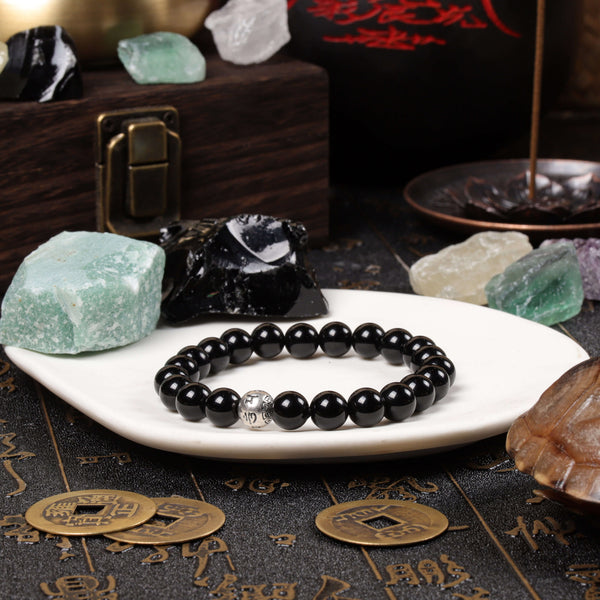
Natural Black Obsidian (Yin Anchor): Formed by volcanic lava rapidly cooling into natural glass, obsidian is dense, protective, and deeply grounding—ideal for absorbing stress and centering scattered energy.
Luminous Moonstone or Clear Quartz (Yang Spark): Translucent and bright, these stones reflect light and clarity—ideal for stimulating intuition, vision, and mental freshness.
Traditional Guidelines: Left vs. Right Wrist
The Left Wrist (Receptive Yin): Traditionally viewed as the side that receives internal peace, grounding energy, and mindful awareness.
The Right Wrist (Expressive Yang): Traditionally viewed as the side that projects strength, releases pent-up emotional stress, and takes action.
Choose whichever wrist feels most comfortable and supportive for your daily movement.

Pop Culture, Tattoos, and Commercial Usage
The Taijitu’s clean geometry and timeless meaning have made it a permanent fixture across global media:
Tattoos as Personal Declarations: Yin-Yang tattoos frequently celebrate life resilience, emotional integration, and acceptance of light and shadow within oneself. Combining the emblem with swimming koi, lotus petals, or celestial suns personalizes the journey.
Public Domain Cultural Heritage: The classical Taiji diagram belongs to the public domain as ancient human cultural heritage. Anyone can freely incorporate it into fine art, graphics, or apparel.
Trademark & Commercial Caution: While the universal symbol is free to use, specific modern stylized brand logos, proprietary artistic fonts, or commercial trademarks derived from it are protected by intellectual property laws. Designers should always craft their own original interpretations.
Frequently Asked Questions (FAQ)
What does the Yin Yang symbol mean?
The Yin Yang symbol (Taijitu) represents the unity of opposites, dynamic balance, and continuous mutual transformation. The interlocking black and white waves illustrate the rhythmic waxing and waning of natural energies, while the opposing dots reveal that every state carries the seed of its counterpart.
Is the Yin Yang symbol a religious icon?
Yin-Yang philosophy originated as an observational nature philosophy in ancient China long before institutional religions developed. While later integrated into Daoism and Confucian thought, it functions broadly as a philosophical, architectural, aesthetic, and lifestyle framework accessible to people of all backgrounds.
Which is Yin and which is Yang in the symbol?
In the traditional emblem, the black half is Yin and the white half is Yang. Energetically, qualities that are warming, expansive, upward-moving, and active belong to Yang; qualities that are cooling, inward-moving, still, and receptive belong to Yin.
Is Yin black or white?
Yin is black, and Yang is white. The black area represents shadow, night, stillness, and restorative depth; the white area represents light, daylight, warmth, and active expression.
Is the Yin Yang symbol clockwise or counter-clockwise?
Both orientations are authentic. The clockwise flow is common in modern art, representing seasonal progression and temporal creation. The counter-clockwise flow appears in esoteric Daoist meditation manuals, symbolizing the inner alchemical return toward quiet stillness.
Should the black side be on the left or the right?
Both arrangements are historically valid. Placing black on the left aligns with ancient southern-facing cosmological charts, while placing black on the right aligns with contemporary left-to-right visual reading preferences.
What is the difference between the Yin Yang symbol and the Taiji symbol?
They refer to the same design from different perspectives:
-
Yin and Yang describes the complementary polarities depicted within the circle.
-
Taiji refers to the primordial whole that holds both forces together.
-
Taijitu is the official name of the diagram itself.
What do the koi fish represent in a Yin Yang design?
The dual koi fish symbolize perseverance, fluid harmony, and grace under pressure. Circling head-to-tail, they represent moving smoothly with life's currents rather than fighting against natural cycles.
Can you get a Yin Yang symbol tattoo?
Yes. Yin-Yang tattoos are widely embraced worldwide as personal emblems of inner peace, emotional balance, and resilience through change. Select an artist who approaches the sacred geometry with cultural respect.
Are there copyright issues with using the Yin Yang symbol commercially?
The traditional Taiji diagram belongs to the public domain as world cultural heritage and can be freely used. However, specific contemporary artistic renderings, unique designer fonts, or registered commercial brand logos may carry copyright or trademark protections. Always create original visual assets for commercial products.



Leave a comment